
Publications and Resources
From climate change to online disinformation, our publications provide evidence-based, nonpartisan insight from top scholars and practitioners into complex global challenges. IGP publications draw on the latest research from Columbia University and beyond to bring together diverse perspectives and provide practical recommendations to guide policy action around the world. IGP’s Faculty and Fellows also author a variety of resource guides for students, faculty, policy makers, and the general public on a host of issues related to policy engagement and work.
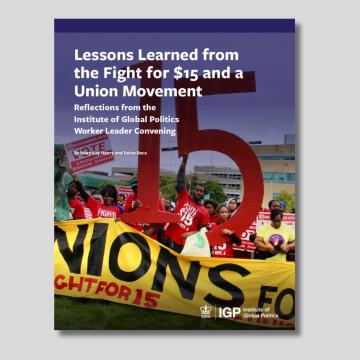
Lessons Learned from the Fight for $15 and a Union Movement
Authors: Mary Kay Henry and Dylan Baca
What began in 2012 with a few hundred fast-food workers striking in New York City for a $15 minimum wage and union rights grew into a nationwide movement that helped raise wages for millions of workers, reshape public debates about economic justice, and redefine what was considered politically possible. Drawing on a November 2025 convening of worker leaders hosted by the Institute of Global Politics at Columbia University, as well as research and reflections from worker leaders, organizers, scholars, and advocates, this paper captures the experiences and lessons of those who helped build the movement.
First Forum on Democratic Evolution: The Information Environment
Author: Avril Haines
Emerging technologies, shifting media habits, and artificial intelligence are rapidly destabilizing the contemporary information environment, creating complex challenges for democratic governance. As the first report in a series on democratic innovation, this paper synthesizes insights from a February 2026 forum of leading scholars and practitioners. The report outlines the primary risks to civic life, breaks down proposals alongside their key trade-offs, and highlights the most promising paths forward to safeguard public discourse.
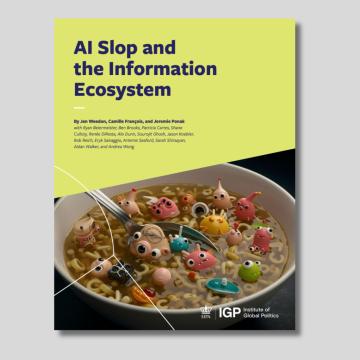
AI Slop and the Information Ecosystem
Authors: Jen Weedon, Camille François, and Jeremie Ponak
AI slop is not just low-quality content, deep fakes, or a moderation headache. It's bigger than that, signifying a deeper shift in platform incentives, political communication, and how knowledge gets produced online. This report is the most definitive and the first interdisciplinary attempt to define AI slop and demonstrate how cheap AI generation, algorithmic distribution, and engagement-driven monetization are reshaping the internet. The findings were informed by a closed-door convening of 20 experts, from frontier AI labs, social platforms, investigative journalism, and academia, held under Chatham House Rule with support from the Hewlett Foundation.
In Defense of Multilateralism: The UN We Must Aspire To
Authors: Scott Barrett, Jean-Marie Guéhenno, Daniel Naujoks, José Antonio Ocampo, Ben Orlove, Jyotsna Puri, Dirk Salomons
As a group of scholar–practitioners who have witnessed, shaped, reformed, studied, and criticized multiple different aspects of multilateral cooperation, we understand many of the critiques. We also see that many of the critiques misunderstand what the UN is and how it operates, as well as its potential. We believe that it is paramount to emphasize why a well-functioning UN is essential for the well-being of each nation, all people, and the planet. This report highlights 10 key distinctions that are essential for any meaningful discussion of the successes, failures, and reform needs of the UN; emphasizes 10 major UN achievements that illustrate the significant impact multilateral cooperation can have; and outlines 10 core recommendations to create the UN we must aspire to.
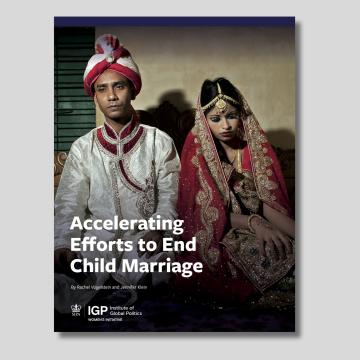
Accelerating Efforts to End Child Marriage
Authors: Rachel Vogelstein and Jennifer Klein
Child marriage is not only a human rights violation—it is also an economic issue. Estimates show approximately 12 million girls are still married before the age of 18 each year. This report from the Women's Initiative at Columbia's Institute of Global Politics, which features new research produced by the Center for Global Development, shows that the costs of inaction on child marriage are staggering, with estimated losses of up to $175 billion per year, or almost $2.5 trillion by 2040. Furthermore, recent challenges—including significant cuts in foreign assistance, the waning global commitment to women’s human rights, and growing conflict and crises—threaten to slow or even reverse progress.
This report outlines a strategy to accelerate progress to reduce child marriage and avoid its considerable costs—including by (1) investing in girls’ education, (2) promoting health services to reduce adolescent pregnancy, and (3) shifting norms that perpetuate this practice. Addressing child marriage is not only a moral imperative—it is a strategic imperative we cannot afford to overlook, which will improve the health, education, and economic prosperity of entire communities and nations.
Praise for Accelerating Efforts to End Child Marriage
-
Alice P. Albright, former CEO of Millennium Challenge Corporation:
“Child marriage not only violates girls’ rights—it also undermines their health, education, and future economic participation and creates an intergenerational cycle of poverty. This report highlights why ending child marriage is critical to economic development and outlines an evidence-based strategy to achieve this critical goal.”
Ajay Banga, President of the World Bank Group:
“This report makes clear that ending child marriage is fundamental to building human capital and expanding economic opportunity. When girls stay in school, access health services, and delay early marriage, they are far more likely to enter the workforce, earn higher incomes, and contribute productively to their communities — and live lives of dignity and confidence. That strengthens families, deepens the talent pool, and supports job creation.”
Secretary Antony J. Blinken, 71st United States Secretary of State:
“Child marriage violates the fundamental rights of girls. As the Institute of Global Politics report makes clear, it also undermines health, education and economic stability around the world. That's why preventing child marriage is both a moral imperative and vital to advancing opportunity and security for communities and nations alike.”
Bono, lead singer of U2 and Co-Founder of ONE:
“Ripping a child from her family, her friends, her education rips away her future. As Malala has said, child marriage is not a tradition sent from heaven, it is man-made—and men should argue as hard as women to change it. That means changing laws, but also fighting vicious cycles of extreme poverty which deny girls the education and opportunity to make their own decisions.”
Secretary Hillary Rodham Clinton, Professor of International and Public Affairs and IGP Faculty Advisory Board Chair at Columbia SIPA, 67th United States Secretary of State and former Senator from New York:
“This report makes clear that we can’t realize our economic potential without the full participation of women and girls in society. The cost of inaction — to young girls robbed of their futures, to the communities who forfeit their brilliance, and to a shared future untouched by their passion — is far too high to ignore.”
Senator Joni Ernst, United States Senator from Iowa:
“Child marriage is a serious problem which particularly puts young girls at risk. My hope is for future generations of women to enjoy their childhoods and pursue education and economic opportunity. Through practical solutions, I’m encouraged that lasting progress can be made for young girls around the world, their futures, and their communities.”
Noah Feldman, Arthur Kingsley Porter University Professor, Harvard University:
“Child marriage is a moral wrong that causes grave harm to girls. Failure to enforce legal rules against child marriage is an independent wrong—the wrong of unequal protection of the laws. When girls are denied the legal and moral right to consent to marriage, the state has failed in its most basic duty to guarantee autonomy. As the report shows, to end child marriage, we must find legal and cultural tools to enforce existing laws that recognize girls as rights-bearing individuals.”
Jon Finer, former Principal Deputy National Security Advisor:
“Child marriage is not only a human rights violation—it is also a practice that fuels poverty and is associated with conflict and instability. This report provides a compelling and practical strategy to accelerate progress to reduce child marriage and avoid the significant cost of inaction.”
Hon. Henrietta Fore, former Executive Director of UNICEF and former USAID Administrator:
“To end child marriage, culture is the key. A cycle of poverty is perpetuated. A girl child drops out of school. A girl child has a child. Read the report and join the call to action to end child marriage.”
Dr. Claudia Goldin, Samuel W. Morris University Professor, Lee and Ezpeleta Professor of Arts and Sciences, and Henry Lee Professor of Economics at Harvard University, and Nobel Prize-Winning Economist:
“Child marriage robs a girl of her own childhood and society of a productive and educated citizen. Her society would be better off, and she would be safer and healthier if child marriage could be ended. There is no defensible reason for it.”
Dr. Gita Gopinath, Gregory and Ania Coffey Professor of Economics at Harvard University and former First Deputy Managing Director of the International Monetary Fund:
“This report demonstrates that child marriage is not only a social challenge but a significant economic concern. By quantifying the long-term costs to productivity, labor force participation, and fiscal stability, it makes a compelling case for investing in girls as a driver of economic resilience. Sound economic policy must include sustained investment in girls’ education and health.”
Ambassador Mark Green, former USAID Administrator, United States Ambassador to Tanzania, and United States Representative from Wisconsin:
“Child marriage is a stain upon any society that permits it. It not only undermines human dignity, but as this report makes clear, it limits a country’s prospects for economic progress and achievement.”
Secretary John Kerry, 68th United States Secretary of State:
“Jennifer Klein and Rachel Vogelstein have masterfully articulated not just why child marriage is a theft of childhood and a violation of basic human dignity, but why addressing this abuse is a national security imperative. Societies and governments that protect girls’ fundamental right to choose their own futures not only prevent human suffering, they reap benefits in stability, health, and prosperity for all.”
Senator Amy Klobuchar, United States Senator from Minnesota:
“Protecting girls and ensuring they can choose their own future is critical to lifting up communities and fostering economic opportunity. This report shines a light on the urgent need to prevent child marriage and support girls across the globe.”
Christine Lagarde, President of the European Central Bank and former Managing Director of the International Monetary Fund:
“There is a time for everything. There’s a time for school. There is a time for marriage. School comes first.”
Secretary Jacob J. Lew, 76th United States Secretary of the Treasury and former United States Ambassador to Israel:
“The IGP Women's Initiative report is an important contribution for policy makers and philanthropic donors to understand and address this problem. Importantly, the report documents the economic as well as the human impact of child marriage, making clear that ending child marriage will not only prevent human suffering, it will enhance economic growth, and it offers common sense suggestions for future action.”
David Miliband, President and CEO of the International Rescue Committee and 74th UK Secretary of State for Foreign and Commonwealth Affairs:
“This report demonstrates that child marriage is not only a social challenge but a significant economic concern. By quantifying the long-term costs to productivity, labor force participation, and fiscal stability, it makes a compelling case for investing in girls as a driver of economic resilience. Sound economic policy must include sustained investment in girls’ education and health.”
Michelle Nunn, President and CEO of CARE:
“This report brings together the evidence and experience that organizations on the ground like CARE have seen for years. Child marriage can be prevented when girls are supported, families have options, and communities are engaged. The research shows how to move from isolated programs to change at scale. This is both possible and necessary.”
Michelle Obama, former First Lady of the United States and founder of the Girls Opportunity Alliance:
“Every girl deserves a chance to live a life worthy of her dreams—and that’s only possible in a world without child marriage. This new report shines a powerful light on the urgency of ending child marriage, how much progress we’ve made so far, and how much work we have left to do. And it lays out a path toward unlocking a more equitable future for girls and building a better world for us all—if we’re willing to take it.”
Secretary Condoleezza Rice, 66th United States Secretary of State:
“During my time as Secretary of State, I saw firsthand that nations cannot build stable democracies or prosperous economies while half their population is denied the chance to learn, to grow, and to choose their own futures. Child marriage is not only a fundamental violation of human dignity, but a barrier to global stability. Meeting this challenge in the 21st century will require strong leadership and a long-term commitment to development, because the cost of doing nothing is simply too high.”
Senator Jacky Rosen, United States Senator from Nevada:
“Child marriage is a gross violation of human rights that robs girls of their childhood, education, health, financial independence, and so much more. Every year, millions of girls around the world are forced into marriage and their future pays the price; we cannot look away. This report shines a light on the overwhelming scope of this crisis and the urgent action needed to end it. Preventing child marriage must remain a U.S. and global priority, and I’m proud to stand with advocates working to ensure every girl has the freedom and opportunity to determine her own future.”
Secretary Robert E. Rubin, 70th United States Secretary of the Treasury:
“Pulling girls out of school and into marriage loses years of learning, growth and productivity for them and for their countries' economies. This report shows that ending child marriage is not only about protecting girls—it is about securing a stronger economic future for everyone.”
Catherine Russell, Executive Director, UNICEF:
“Every girl forced into an early marriage or early childbearing is a tragedy—for the girl, for her community and for her country. Adolescent girls who are healthy and educated are critical to successful development.”
Sheryl Sandberg, Founder of Lean In:
“While we rarely talk about child marriage in economic terms, we should remember the concrete costs in lost productivity and higher health-care expenditures, and the incalculable squandering when each girl’s ingenuity and ideas are extinguished.”
Jake Sullivan, former United States National Security Advisor:
“Ending child marriage is both a moral imperative and a smart investment for long-term economic growth. This report makes it clear that investing in efforts to reduce child marriage will advance prosperity and stability for nations around the world.”
Secretary Janet L. Yellen, 78th Secretary of the Treasury and former Chair of the Federal Reserve Board of the United States:
“Accelerating Efforts to End Child Marriage is a clear, evidence-driven call to action—and a reminder that ending child marriage is both a moral imperative and an economic one. Vogelstein and Klein show that the price of inaction is enormous—up to $175 billion each year—and that even in a resource-constrained world, we can make real progress by focusing on what works: keeping girls in school, expanding adolescent health services, and shifting the norms that sustain this practice. Policymakers should read this report—and then move quickly from commitment to implementation.”

The Freedom to Create? Toward Openness and Pluralism in AI’s Future
Authors: Camille François and Mark Surman
In a world increasingly shaped by artificial intelligence, the question of creative freedom takes on new urgency. Camille François and Mark Surman examine both the promises and pitfalls of generative AI, highlighting its potential to foster or stifle diverse artistic expression. Emphasizing the importance of open-source principles, they advocate for approaches that empower creators, safeguard cultural richness, and democratize technology. Drawing from the work of artists and activists worldwide, they argue that AI’s trajectory is not predetermined; rather, it is shaped by our collective decisions to build a more inclusive and imaginative digital future.
Not Enough Seats, Prices Too High: NYC’s Perilous Childcare Math
Authors: Ester Fuchs, Giulia Leila Travaglini, and Ashley MacQuarrie-Tomey
Columbia University’s Communities Speak Surveys find New York’s families are seriously impacted by the loss of COVID-19 era income support. They are again facing challenges in finding accessible and affordable childcare, deepening their financial struggles.
NYC’s Housing Hardship: Evidence from the 2025 Communities Speak Survey
Authors: Ashley MacQuarrie-Tomey, Jonathan Echavarria, Harini Sundararajan, and Ester Fuchs
The Columbia University Communities Speak survey finds that New Yorkers are experiencing historic challenges in housing affordability. The challenges are especially acute for low-income households, Black and Hispanic residents, people with disabilities, non-English-speaking households, and communities in the Bronx.
Beijing+30: A Roadmap for Women’s Rights for the Next Thirty Years
Authors: Jennifer Klein, Rachel Vogelstein, and Lauren Hoffman
This year marks the thirtieth anniversary of the 1995 United Nations (UN) Fourth World Conference on Women in Beijing, a watershed moment in the fight for women’s rights, where 189 nations adopted an ambitious Platform for Action to achieve the full and equal participation of women and girls. While the past three decades have produced important gains, this work remains unfinished, and new challenges threaten to reverse progress for women and girls. This report, produced by the Women’s Initiative at Columbia's Institute of Global Politics and GWL Voices, provides an actionable roadmap to advance the full and equal participation of women and girls in the twenty-first century—including in the areas of democracy and human rights, technology, economic participation, and conflict and climate. The report also proposes key levers designed to accelerate the pace of change, including innovative financing, institutional leadership and reform, coalition building, and improved data and research. It concludes with a call to accelerate action towards fulfilling the Beijing Platform and realizing the promise of women’s human rights once and for all.
How New York State Lawmakers Can Help Address Debt Crises in the Global South
Authors: Martín Guzmán and Joseph E. Stiglitz
New York State law has enormous implications for sovereign debt sustainability and debt crises resolutions, a central problem today in countries across the Southern Hemisphere. Because a large share of the international financial sector is based in New York, about 50 percent of global sovereign bonds are issued under New York State law. As there is no international legal framework for resolving situations of unsustainable sovereign debts, New York law is even more consequential. In this report, How New York State Lawmakers Can Help Address Debt Crises in the Global South, co-published by Initiative for Policy Dialogue (IPD) and Institute of Global Politics (IGP), Martin Guzman and Joseph E. Stiglitz explain why reforming New York State law is an urgent priority for resolving debt crises and present three main proposals for reform.
It’s Everyone’s Problem: Mainstreaming Responses to Technology-Facilitated Gender-Based Violence
Authors: Nina Jankowicz, Isabella Gomez-O’Keefe, Lauren Hoffman, and Andrea Vidal Becker
Technology facilitated gender-based violence (TFGBV) is not an intractable problem. But it must no longer be the responsibility solely of women’s advocacy groups. Others – technology companies, governments, civil society organizations, law enforcement, businesses, schools – must step up and work in unison to combat TFGBV in order to to reflect its mainstreamed effects on society. This new IGP report, drawing on a case study around the online harassment of Australian eSafety Commissioner Julie Inman Grant, assesses the state of research on TFGBV as well as recent global policy progress made on this issue, and offers a number of practical solutions to make women and girls safer online.

Online Foreign Information Operations Targeting Elections
Authors: Margot Fulde-Hardy and Camille François
In 2016, a large-scale information operation targeted the US presidential election, catalyzing new fields of study and practices on the modern practices of foreign interference. Researchers still lack a unified view and analytical framework to make sense of these operations. To help put these in perspective and to encourage further research on information operations online, the Institute of Global Politics (IGP) released a comprehensive dataset expanding upon existing databases of foreign information manipulation and interference (FIMI) spanning 2014 to 2024 and specifically targeting elections.
The database will help researchers, journalists, and policymakers contextualize issues associated with online information operations risks ahead of worldwide elections in 2024 and beyond, as well as global events such as the Olympic Games and recently exposed persistent campaigns moving to new platforms.
Margot Fulde-Hardy is a former researcher at the French Agency in charge of countering foreign information manipulation (VIGINUM), and Investigator at Graphika. This research was conducted with the Institute of Global Politics, independent of and prior to her current and former affiliations.
Camille François is an Assistant Professor of Professional Practice in the Faculty of International and Public Affairs and IGP Affiliated Faculty at Columbia SIPA
Towards a Framework for Openness in Foundation Models: Proceedings from the Columbia Convening on Openness in Artificial Intelligence
Authors: Adrien Basdevant, Camille François, Victor Storchan, Kevin Bankston, Ayah Bdeir, Brian Behlendorf, Merouane Debbah, Sayash Kapoor, Yann LeCun, Mark Surman, Helen King-Turvey, Nathan Lambert, Stefano Maffulli, Nik Marda, Govind Shivkumar, Justine Tunney
The Institute of Global Politics (IGP) and Mozilla worked with leading artificial intelligence scholars and practitioners to create a framework on openness and AI. The May 2024 paper surveys existing approaches to defining openness within AI models and systems, and then proposes a descriptive framework to understand how each component of the foundation model stack contributes to openness.
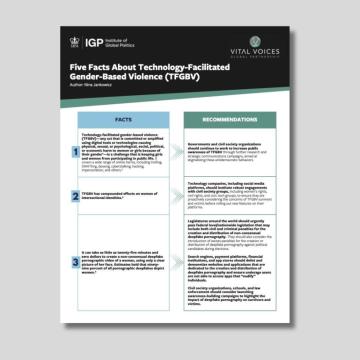
Five Facts About Technology-Facilitated Gender-Based Violence (TFGBV)
Author: Nina Jankowicz
Together with Vital Voices Global Partnership, IGP published a factsheet, Five Facts About Technology-Facilitated Gender-Based Violence (TFGBV), authored by Nina Jankowicz, Co-Founder & CEO of The American Sunlight Project and Adjunct Professor, Syracuse University. The factsheet outlines key facts relating to TFGBV and recommendations for addressing it.
The Future We Choose: Building a Future of Work that Leaves No Young Person Behind
Authors: Saru Duckworth and Henrietta Fore
Slow progress on education and poverty reduction is costing young people their futures. Authors Saru Duckworth, an IGP Student Scholar, and Henrietta Fore, an inaugural IGP Carnegie Distinguished Fellow, worked together as the lead authors of the report published by the Next Generation Fellows and United Nations Foundation in partnership with IGP. The report marks one of the most significant collaborations to date between one of IGP’s Carnegie Distinguished Fellows and an IGP Student Scholar.
The Pursuit of Truth: Fixes for the Spread of Online Mis/Disinformation
Author: Anya Schiffrin
The European Union has politically agreed on the world’s most far-reaching attempt to rein in the powers of Artificial Intelligence. At the heart of the matter is the dangers posed by generative AI systems like ChatGPT to produce text, spread dis/misinformation and fake news virally, and create illegal content. The global information ecosystem, in short, is at a crossroads. In this new study, Anya Schiffrin, director of the Technology, Media, and Communications at Columbia SIPA, examines the promise and pitfalls of demand-side (awareness raising, fact-checking) versus supply-side (government regulation, content moderation) solutions to ensure a healthy ecosystem of information while also maintaining freedom of expression.
Addressing the 'Wicked' Problem of Climate Change
Authors: Joseph Stiglitz, Scott Barrett, and Noah Kaufman
The COP28 summit in Dubai revealed the difficulties of finding global consensus around climate change, a “wicked problem” that defies easy solutions. Early prescriptions for climate solutions focused on idealistic "optimal" policies and all-encompassing global treaties. With global emissions still climbing, more radical reductions are needed sooner and new approaches to promote global collective action. In this IGP report, three Columbia economists — Joseph Stiglitz, a Nobel Laureate in economics, Scott Barrett, a leading climate economist, and Noah Kaufman, a former White House senior advisor on climate economics — describe a more nuanced, realistic, and strategic vision for climate progress.

Reducing Administrative Burdens
Author: Alexander Hertel- Fernandez
Each year, millions of individuals, families, and small businesses eligible for public benefits or services fail to receive the support to which they’re entitled as a result of administrative burdens – the time, stress, and resources it takes to complete required applications and processes. IGP Faculty Advisory Board Member and Associate Professor of International and Public Affairs, Alex Hertel-Fernandez, participated in a webinar hosted by The Scholars Strategy Network and Washington Center for Equitable Growth on how academics can write comments to the federal government to reduce administrative burdens.