Upcoming Events
Upcoming Events
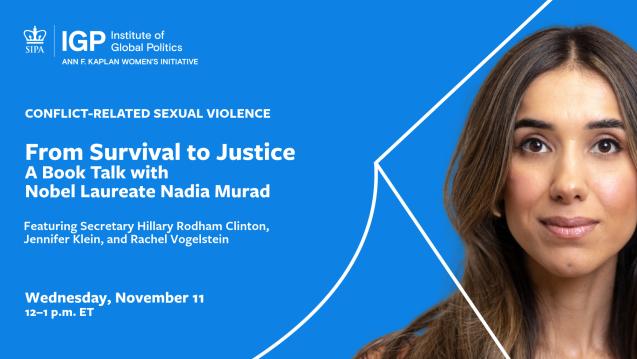
Join the Institute of Global Politics (IGP) and Nobel Peace Prize Laureate and human rights activist Nadia Murad for a discussion on her new book, I Choose My Beginning. Drawing on her experience as a survivor of conflict-related sexual violence (CRSV), Murad examines the path from survival to justice and the importance of accountability of perpetrators of sexual violence in conflict. The discussion will explore the role of international law and policy in advancing justice for survivors, as well as ways to ensure that the voices of those affected by CRSV are reflected in efforts to prevent future atrocities. At the event, the IGP Ann F. Kaplan Women’s Initiative will release a new policy blueprint outlining reforms to promote accountability for CRSV to further prevention, deterrence, and long-term peacebuilding.
Speakers will include Secretary Hillary Rodham Clinton, Jennifer Klein, and Rachel Vogelstein.
What Does It Take to Lead a 21st-Century Democracy?
In a democracy, leaders and citizens are locked in a constant back-and-forth: each sometimes leads the other, and each sometimes follows. When should elected leaders push back against the public, and when should they give it what it wants? This tension is inherent in representative democracy, but it has only grown harder to navigate in an age of political polarization, distrust, and democratic erosion. This event brings together scholars and practitioners to ask what it takes to govern effectively in a democracy today and how universities can help educate the leaders of tomorrow.
Why has liberal democracy not lived up to its promises? Join Columbia SIPA’s Institute of Global Politics and the Center for Political Economy as economist and Nobel Laureate Daron Acemoglu delivers the Investcorp Lecture in International Finance and Business, discussing his new book, What Happened to Liberal Democracy? Remaking a Politics of Shared Prosperity. The conversation will explore how liberal democracy has failed to deliver shared prosperity, public goods and services, and a voice for the working class. Acemoglu argues that to reverse the backsliding of democracy, we need a new governing philosophy. He shares his ideas for working-class liberalism, an approach that prioritizes shared prosperity and issues that matter to everyone, not just a narrow elite.
This event will be introduced by Alan Taylor and moderated by Jeffry Frieden.
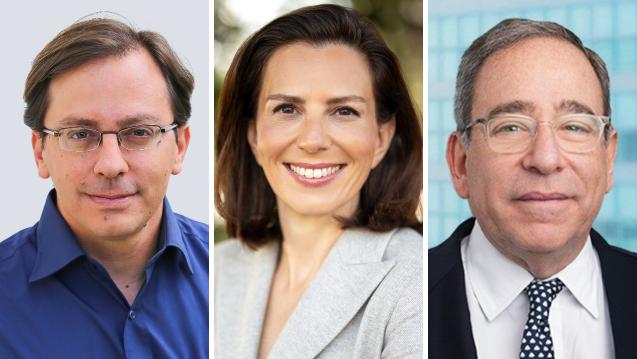
Israel’s October election could prove to be one of the most consequential in the country’s history, reshaping not only Israel’s domestic politics, but its relationship with the United States and its role in a rapidly changing Middle East.
Join Columbia University SIPA Dean Keren Yarhi-Milo, former US Ambassador to Israel Tom Nides, and leading Israeli journalist and Senior Research Scholar at Columbia SIPA Nadav Eyal for a timely conversation examining the election results, potential avenues for the next coalition/government, and how these elections will shape Israel's policies going forward.
Bringing together perspectives from academia, diplomacy, and journalism, the discussion will look beyond the immediate headlines and political maneuvering to ask the larger questions: What direction have Israeli voters chosen? What could the election mean for Israel’s relationship with Washington and the US, the Palestinians, and its regional partners? And after years of war and political upheaval, where does Israel go from here?
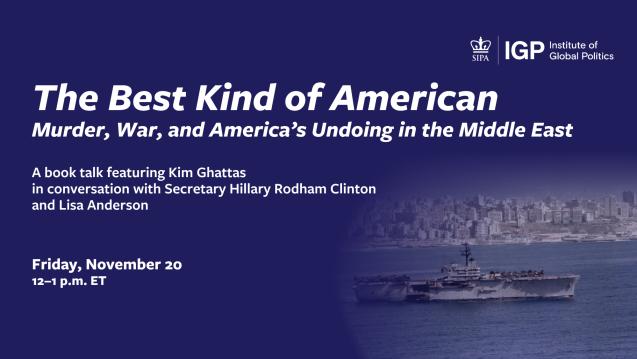
The Best Kind of American
Join Emmy Award-winning journalist and author Kim Ghattas for a discussion of her new book, The Best Kind of American: A True Story of Murder, War, and America’s Undoing in the Middle East. The book explores the 1984 murder of an American university president in Beirut, Malcolm Kerr, and the forces that reshaped the Middle East and US foreign policy in the decades that followed.
His murder serves as the starting point for a sweeping account that weaves together the Kerr family’s search for answers with the stories of Lebanon’s warlords and peacemakers, Hezbollah hostage takers, Iranian Revolutionary Guards, and US presidents from Reagan to Trump.
In conversation with Secretary Hillary Rodham Clinton and Lisa Anderson, Ghattas will discuss her investigation and what it reveals about US foreign policy in the region.
Recent Events
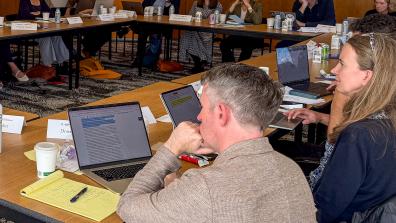
In October 2026, a group of 26 interdisciplinary social scientists, legal scholars, and policy experts from institutions across the United States and Europe gathered at Columbia’s School of International and Public Affairs (SIPA) for a workshop to discuss these questions.
The two-day event was convened by the American Democracy Initiative at Columbia’s Institute of Global Politics (IGP) and theConsortium on the American Political Economy (CAPE) with an ambitious goal in mind: to sketch out a research agenda for the next chapter of the study of the American political economy.
Participants did not present finished papers. Instead, each circulated a three-page memo in advance, making the case for an area that deserves more scholarly attention going forward. Participants then took stock of what has changed (e.g., the role of money in politics), what has not (bipartisan indifference to addressing it), and where research is most needed: the role of mega-wealthy individuals in our economy and democracy, international supply chains, how AI will affect democratic governance, whether the world will keep investing in American assets, and how a transformed administrative state will function, among other questions.
A central theme throughout the event was that the era of “business as usual” has come to an end. In talk after talk, participants doubted that the US would revert to the old normal and urged colleagues to revisit long-settled assumptions about how the American political economy works.
As Paul Pierson (UC Berkeley) put it reflecting on the historically large cuts to the safety net enacted under the second Trump Administration through the One Big Beautiful Bill Act: “As a person who made a living out of telling people it’s politically impossible to cut the welfare state, I’m beginning to think they may have finally cracked the code.”
Alexander Hertel-Fernandez, SIPA faculty lead for the American Democracy Initiative, explained that while this workshop was focused on identifying the need for new areas of academic research, much of the discussion had direct implications for policymakers in areas as diverse as financial regulation, labor, tax, and public infrastructure. “Before policymakers can make effective proposals, we need to establish a clearer picture of the changing economic and political context. That’s what this workshop aimed to do.”
CAPE is an international network of scholars committed to fostering the study of markets and politics in the United States in comparative and historical perspective, and supports this work through an annual summer academy for junior scholars, small grants, teaching resources, an annual conference, and workshops like this one.
The American Democracy Initiative supports research and policy development to strengthen democracy in the United States, including by understanding how economic policy shapes the resilience of democratic norms and institutions.
IGP hosted a webinar with a panel of experts and practitioners taking stock of US-Ukraine relations, situating recent developments in the broader war, and discussing Ukrainian defense technology and what the US can learn from it.
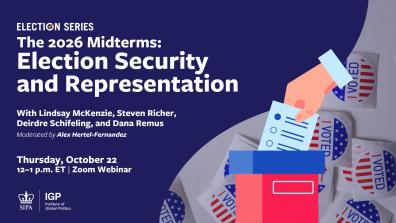
IGP hosted a webinar with political analysts discussing election integrity, political representation, and ballot access ahead of the 2026 midterm elections.