The State of the World Conference and IGP Report Mark 80 Years of Multilateralism at the United Nations
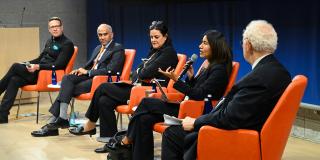
Six months after the United Nations (UN) marked its 80th anniversary, the institution faces growing questions about its effectiveness amid budget pressures, geopolitical tensions, and debates over the future of multilateral cooperation. Columbia SIPA’s UN Partnership Initiative and the Institute of Global Politics (IGP) convened the second annual “State of the World” conference on April 21 to reflect on this critical moment, coinciding with the launch of a new IGP report, In Defense of Multilateralism: The UN We Must Aspire To, authored by a group of SIPA professors.
The conference featured panels on sustainable development, a healthy planet, and peace and global order, bringing together sitting ambassadors, senior UN officials, SIPA faculty, alumni, and students.
Daniel Naujoks, faculty director of SIPA’s UN Partnership Initiative and one of the authors of the report, opened the conference by urging audiences to resist sweeping indictments of an institution that operates in more than 190 countries. He explained that the IGP report identifies 10 key distinctions for making sense of the UN, 10 of its major achievements, and 10 recommendations for reform, describing the report as a “compass” for the current moment. “Any generalizing claim that ‘the UN is…’ is necessarily wrong,” he said.
In the first panel, Karima El Korri, director of sustainable development at the Executive Office of the UN Secretary-General, outlined the financial pressures facing the multilateral system, noting that official development assistance fell by 23 percent in 2025 and that the UN system’s budget is projected to shrink by 25 percent. Ambassador Parvathaneni Harish, India’s Permanent Representative to the UN, defended the organization’s track record on development, while calling for substantive Security Council reform, describing that body as “an institution created by our grandparents that is completely out of sync for our grandchildren.”
José Antonio Ocampo, co-director of SIPA’s Economic and Political Development Concentration and co-author of the IGP report, renewed his call for a Global Economic Cooperation Council to bring the World Bank, IMF, and WTO into closer alignment with the UN system. SIPA student Dámaris Herrera Salazar, who spent five years at UN Development Program (UNDP) in Peru before joining SIPA, illustrated the UN’s on-the-ground impact through a project that grew from $50,000 to over $2 million, reaching 3,000 vendors across 40 markets in seven regions. “The UN is not going to a place to bring development,” she said, “but to unlock and connect the actors and the capacities that already exist in the territories.”
In the day’s second panel, Jamil Ahmad, director of intergovernmental affairs at the UN Environment Program, traced environmental diplomacy from the 1972 Stockholm Conference to the more than 500 multilateral environmental agreements now in force. SIPA Professor Ben Orlove highlighted the 1987 Montreal Protocol and the 2021 conclusion of the International Panel on Climate Change that human-caused warming is “unequivocal” as two major multilateral achievements. Aparajita Rao, climate change program manager at Perry World House and a SIPA alumna, urged audiences to preserve, strengthen, and supplement what the multilateral climate architecture has already built.
In the final panel, Annalena Baerbock, Germany’s former foreign minister and current president of the 80th session of the UN General Assembly, pushed back against narratives of institutional decline at the UN, noting that a two-thirds majority of member states continues to stand behind the Charter. Ambassador Brian Wallace of Jamaica argued that smaller states possess extraordinary leverage which they have not yet fully used, calling on the international community to act with courage rather than see themselves as secondary actors in multilateralism. “If the United Nations did not exist, we would have to invent it,” he said. He also stressed the UN’s convening power as “a place where as much as we disagree with each other…the fact is that everybody shows up at this table to have these conversations.” Anoushka Joshi, an MIA candidate at SIPA, drew on her capstone research to argue that the UN’s 2024 decision to integrate a special political mission of the UN into the Office of the Special Envoy in Yemen could serve as a blueprint for more agile and adaptive peace operations.
The State of the World Conference brought together global thought leaders and SIPA student experts on multilateral cooperation and ended with clear reasons why we need the UN, what is working, and what aspects of the world organization and global cooperation are in need of reform.
When asked about advice for young people in this current moment, Ambassador Wallace replied, “Keep that enthusiasm,” reminding the audience that “Realism is not an excuse for cynicism.” President Baerbock also spoke to the youth in the audience: “Dare to stand up…the headwinds are strong, but stay there and unite” – a reminder that after 80 years the future of multilateralism will depend not only on institutions, but also on the people willing to shape and defend them.”
Watch the full conference here:
Welcome & Report Summary by Professor Daniel Naujoks
Panel 1: The UN we must aspire to for Sustainable Development with Amb. Parvathaneni Harish, Permanent Representative of India; Karima El Korri, Director of Sustainable Development, Executive Office of the UN Secretary-General; SIPA Professors José Antonio Ocampo and Daniel Naujoks; and Dámaris Herrera Salazar, MIA Candidate
Panel 2: The UN we must aspire to for a Healthy Planet with Amb. Aida Kasymalieva, Permanent Representative of Kyrgyzstan; Jamil Ahmad, Director, Intergovernmental Affairs, UNEP; SIPA Professors Scott Barrett and Ben Orlove; and Aparajita Rao, Perry World House
Panel 3: The UN we must aspire to for Peace & Global Order with Annalena Baerbock, President of the UN General Assembly; Amb. Brian Wallace, Permanent Representative of Jamaica; SIPA Professor Michael Doyle; Anoushka Joshi, MIA Candidate
Concluding Remarks by Professor Daniel Naujoks
Read the new IGP Report: In Defense of Multilateralism: The UN We Must Aspire To