Image
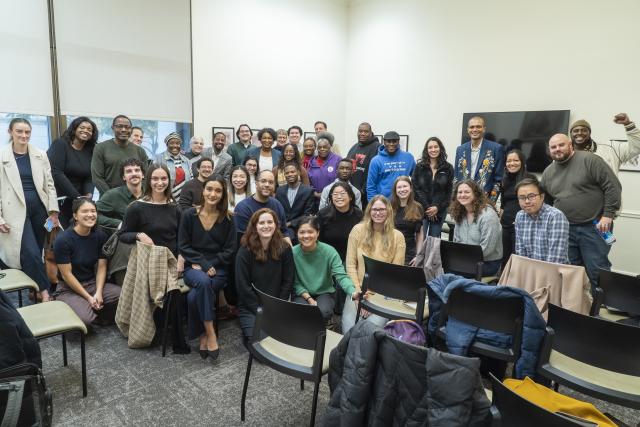

Former Georgia House Minority Leader and inaugural IGP Carnegie Distinguished Fellow Stacey Abrams is fearful for the future of American democracy – but she has a plan to defend against democratic backsliding.
On November 13, the Institute of Global Politics (IGP) convened an American Democracy Initiative roundtable to discuss Abrams’s 10 Steps Campaign, an effort to help citizens identify the warning signs of authoritarianism and resist its rise. The panel featured Abrams alongside Mary Kay Henry, former president of the Service Employees International Union and IGP Carnegie Distinguished Fellow. Alex Hertel-Fernandez, director of the IGP American Democracy Initiative and Herbert H. Lehman Professor of Government, delivered opening remarks.
Abrams outlined her campaign’s 10 Steps to Autocracy, a framework she borrowed from scholars on authoritarianism. The first step for would-be authoritarians is to win an election, which Abrams described as potentially the last fair election. Other steps include capturing the legislative and judicial branches of government, gutting the civil service, and installing loyalists. The tenth and final step is ending democracy itself.
Abrams told the audience that she sees those markers in the United States today, from efforts by the Department of Government Efficiency – known as DOGE – to restructure and raze the federal government (Step 4: gut the civil service) to the ongoing National Guard deployments in American cities (Step 9: normalize violence).
“If you've done those other nine steps, step ten [is] you basically make sure democracy never has another shot,” Abrams said.
Yet Abrams believes American democracy still has a shot, which is why she also created 10 Steps to Freedom and Power – a playbook for resistance that builds on past civil rights and peaceful democratic movements. The first step of this framework, Abrams said, is fully understanding the authoritarian challenge the US faces right now. Steps 2 through 10 follow from there: people must share that knowledge widely; organize; mobilize; use the courts to pursue litigation; participate in nonviolent disruption; deny dehumanizing language; engage with elected officials at all levels of government; elect pro-democracy candidates; and demand a better, more resilient system.
That final step, Abrams emphasized, is critical. “We must demand the nation that we want,” she told students. “What we have was clearly insufficient because it's been overthrown so swiftly.”
Students responded to Abrams’s call to action with a mix of optimism and skepticism. Some questioned how to persuade those who do not believe that US democratic institutions are under attack, or how to demonstrate to others that democratic governments can deliver on people’s material needs, including healthcare and economic security. Other students wondered how they could get involved in Abrams’s campaign, and what it would take to build a more responsive, equitable democracy.
“For me,” Abrams said in closing, “a democracy that is effective says that we all have the basics taken care of, and now we can all fight for what we want next.”