President of UN General Assembly Vuk Jeremić Hosts IGP Simulation for Students
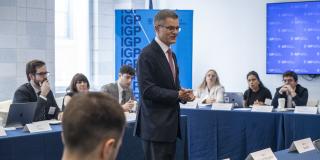
As the tenure of UN Secretary-General António Guterres comes to a close, the process of selecting the next leader of the world’s largest international organization is set to unfold. To date, four candidates nominated by member states are in the race for the position of United Nations secretary-general (UNSG). Against that backdrop, the Institute of Global Politics welcomed Vuk Jeremić to lead a simulation of the UNSG election with some of its Student Scholars. Jeremić is president of the 67th session of the UN General Assembly and a former candidate for secretary-general.
The simulation recreated the rules and procedures that will soon take place at United Nations Headquarters. The United Nations Security Council (UNSC) session, presided over by the representative of Bahrain, heard from six candidates, including the four already announced. Students either role-played candidates or representatives from UNSC member states. Each participant was provided with candidate profiles, as well as a confidential briefing package outlining their assigned member state’s position.
The day began with a brief introduction, followed by candidates’ vision statements and formal statements from Security Council member states. Beyond these moderated discussions, much of the substantive work took place in unmoderated settings, where lobbying and negotiations enabled participants to build alliances and influence outcomes – highlighting the importance of both formal and informal diplomacy.
The simulation unfolded against the backdrop of ongoing global challenges in the real world, including the wars in Gaza and Iran, as well as ongoing hostilities in Sudan, Venezuela, and other countries. Deep divisions among member states and competing visions for the future of the United Nations made consensus difficult to achieve. After three rounds of voting – during which the preferences of the five permanent members (P5) were not disclosed – their votes became visible from the fourth round onward, as they were cast on red ballots. At times, electing a new secretary-general seemed impossible due to persistent vetoes.
After repeated rounds of mock voting and discussions between the P5 and the candidates, a secretary-general was ultimately elected in the simulation: María Fernanda Espinosa, a former president of the UN General Assembly, with 13 votes in favor, two abstentions, and no votes against.
Reflecting on the outcome, Jeremić noted, “It’s a big breakthrough, and the composition of the Secretariat is also very interesting,” referring to the election of the first woman secretary-general and the appointment of an African under-secretary-general for peace operations.