Image
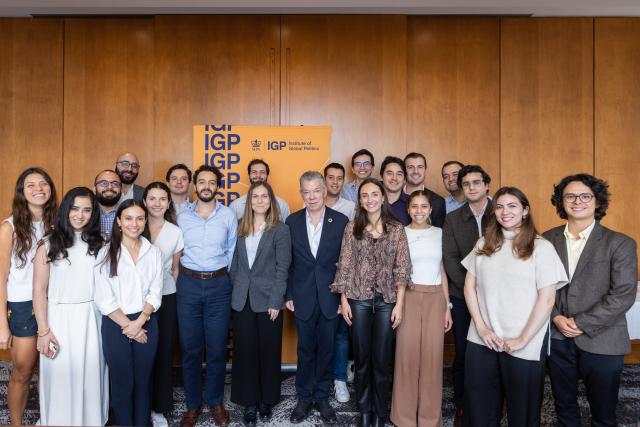
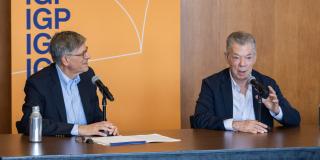
On September 26, the Institute for Global Politics (IGP) hosted a roundtable discussion with Juan Manuel Santos, former President of Colombia and IGP Carnegie Distinguished Fellow, to discuss how nations can foster civil discourse in an era of deep polarization. The event was moderated by SIPA Professor of International and Public Affairs and IGP Faculty Policy Director Jacob Lew, former US Ambassador to Israel and US Secretary of the Treasury. Their conversation was part of SIPA’s event programming during the UN General Assembly week.
As Colombia’s president from 2010 to 2018, Santos achieved international acclaim for brokering a peace deal that ended the country’s decades-long civil war between the government and the leaders of the Revolutionary Armed Forces of Colombia (or FARC), formerly the country’s largest communist guerrilla group. Santos was awarded the Nobel Peace Prize in 2016, following the group’s formal ceasefire. He was lauded for his administration’s emphasis on constructive dialogue, mutual respect, and a victim-oriented approach – priorities he said current leaders lack in today’s political landscape.
“In every country around the world, there is a lack of constructive dialogue. Leaders of countries don’t speak to each other constructively. They speak to each other to impose their ideology or their short-term interests,” Santos said. He urged students to recover the value of constructive dialogue, identifying common denominators across the ideological spectrum.
Drawing from his experience brokering Colombia’s peace negotiations, Santos described dialogue as a crucial centerpiece of his work. He knew that “[Colombia] would never take off as a country without peace,” and said that “for me, that was a tremendous indicator of what my purpose was in life.” By studying previous negotiations in countries such as South Africa, Santos identified three prerequisites for effective peace talks with the FARC: one, preventing the guerrillas from seizing military control to ensure good-faith negotiations; two, ensuring that his adversaries had personal stakes in negotiations; and last, securing cooperation from Colombia’s neighboring countries to block guerrillas from establishing safe havens across borders.
These three priorities ultimately proved successful, strengthened by his administration’s efforts to tackle the root causes of the conflict: economic inequality and land distribution. Following the formal ceasefire, Santos encouraged citizens to participate in the development process, holding thousands of meetings to generate development plans at the community level. Placing the onus on citizens to set priorities was a necessary precondition for peacebuilding that allowed his administration to implement the peace agreements effectively.
Santos’ participatory approach to peacebuilding now informs his work as a member of The Elders, an organization of global leaders founded by President Nelson Mandela to promote peace, justice, and human rights. He reminded the audience of the importance of moderation over radical speech, quoting Mandela: “The most powerful weapon is to sit down and talk.”
For Santos, the principles that transformed Colombia’s peace process have an enduring resonance today. As the roundtable discussion concluded, Santos identified four existential threats facing countries worldwide: nuclear war, climate change, pandemics, and artificial intelligence. To combat these threats, Santos said, “we need to adapt all our institutions to these changing circumstances. The need for cooperation among the countries is, today, much more important and much more needed than ever before.” When asked how young people should approach these daunting challenges, his advice to students was equally direct: “Collectively, you must find a port of destination to move forward.”