James Gorman Kicks off New IGP C-Suite Conversation Series
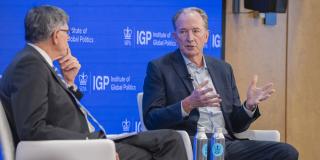
James Gorman, chairman of the board of the Walt Disney Company, spoke to SIPA students on October 8 about his experiences leading through major global challenges, including the 2008 financial crisis. Gorman is an alumnus of the Columbia Business School, as well as a cochair of the Board of Overseers of CBS and a trustee of Columbia University. Jacob Lew, a professor of international affairs at SIPA and former Treasury secretary under President Barack Obama, moderated the talk.
Gorman is perhaps best known for his leadership at the investing firm Morgan Stanley, where he was appointed copresident in 2007 and retired as executive chairman in 2024. Gorman assumed a leadership role at the firm during the global financial crisis, a generation-defining macroeconomic event that led to 10 percent unemployment in the US, shuttered major Wall Street firms, and necessitated more than $400 billion in bailouts from the federal government.
“We had to ensure, number one, [that] Morgan Stanley would survive, so those employees and their families would be supported,” Gorman said of navigating the crisis. “Obviously, without the employees, you're not going to serve clients.”
Rather than taking financial risks that could maximize profit, Gorman said, he tried to make decisions that ensured “Morgan Stanley would be seen as one of the good actors, and would be prudently run with that in mind. And if that meant we would be a little less profitable, a little less daring, I was totally comfortable with that.”
Gorman’s 18-year tenure at Morgan Stanley focused on preparing the firm for the future — not just years down the road, but decades. “You need to think very long term, which gets you to the values, the culture, the leadership, the capability you're building,” he told students. That doesn’t mean that the immediate time horizon isn’t important, but rather that leaders need to understand the long-term implications of their decisions and invest in the right people to steer an institution into the future.
The current geopolitical environment doesn’t offer much in the way of stability, he said, between multiple wars, energy insecurity, climate change, uncertainty about the roles and capabilities of AI, and right-wing retrenchment in many parts of the world. On top of that, Gorman noted, the global economy is due for a crisis in the coming years. It’s a daunting environment, but not without possibility, according to Gorman: “If you're lucky enough to be in a leadership role during a crisis, you should recognize your good fortune and do something with it.”
But for SIPA students and recent grads, those roles are far in the future, so Gorman offered more immediate advice: “Don't define yourself by whether a particular job works out great for you or not. Define yourself by the collection of experiences that enable you to do things later in your life. I'm reinventing. I'm 68, and I'm reinventing myself now — why not?”