Institute of Global Politics Women’s Initiative Inaugurates Conflict-Related Sexual Violence Virtual Roundtable Series
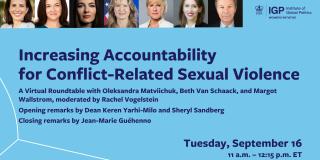
Access to justice is essential to increasing accountability for conflict-related sexual violence. However, this human rights abuse is under-prosecuted at the international and national levels, with punishments often too mild to deter future perpetrators. Building on a February 2024 convening on addressing conflict-related sexual violence, the Institute of Global Politics (IGP) Women’s Initiative inaugurated a new virtual roundtable series on conflict-related sexual violence with a discussion on increasing accountability for this scourge.
Keren Yarhi-Milo, dean of Columbia’s School of Public and International Affairs (SIPA) and Sheryl Sandberg, Board Chair of Sandberg Goldberg Bernthal Family Foundation, opened the September 16 roundtable, which was co-sponsored by the Kent Global Leadership Program on Conflict Resolution. The panel included Ukrainian human rights lawyer Oleksandra Matviichuk, who leads the Nobel Peace Prize-winning organization, Center for Civil Liberties; Beth Van Schaack, former U.S. Ambassador-at-Large for Global Criminal Justice; and Margot Wallström, the first-ever United Nations Special Representative of the Secretary-General on Conflict-Related Sexual Violence and former Kent Visiting Professor at SIPA. Rachel Vogelstein, director of the IGP Women’s Initiative and director of SIPA’s Human Rights, Gender and Equity Concentration, moderated the discussion, and Jean-Marie Guéhenno, director of SIPA’s Kent Global Leadership Program, delivered closing remarks.
“The use of sexual violence as a weapon is deliberate, and it's one of the most devastating realities of war and conflict – and unfortunately, it's on the rise,” said Sandberg during her remarks. Sandberg cited the latest annual report from the UN Secretary-General on Conflict-Related Sexual Violence, which documented a 25 percent increase in cases of sexual violence as a tactic of war, repression, or terrorism — with women and girls comprising 92 percent of the victims of these crimes.
The panelists focused on innovative policy approaches aimed at strengthening accountability, justice, and protection for survivors of conflict-related sexual violence. Drawing on their extensive experience and expertise, they reflected on the complexities of these issues, including the difficulty of collecting evidence, the challenge of underreporting, and the importance of confronting the deep-seated shame and stigma surrounding such cases.
Matviichuk described the situation in Ukraine, where she said sexual violence is widespread, but still remains a “hidden crime.” According to Matviichuk, “[Ukraine’s] Office of General Prosecutor opened more than 180,000 criminal proceedings, but among them, we have only 400 recorded cases related to sexual violence committed during this conflict, which is not appropriate for sure.”
While Ukraine adopted a groundbreaking law in 2024 to provide survivors with interim reparations and has invested in training judges and prosecutors, Matviichuk argued that further measures are needed to strengthen the delivery of justice to further support survivors. “We see how the general system of criminal justice needs to learn more how to put survivors of sexual violence in the center, to respect the dignity of survivors and to look to people not just as a source of evidence,” she said.
The other panelists also discussed recent developments in recognizing these international crimes, tracing their evolution since they were recognized by special international courts, such as the International Criminal Tribunal for the former Yugoslavia and the International Criminal Tribunal for Rwanda. The panelists discussed proposals to add explicit prohibitions against gender-based violence, such as those against forced marriage, to the Draft Articles on the Prevention and Punishment of Crimes Against Humanity, which is currently being deliberated in the United Nations. Matviichuk said such a treaty would strengthen the international protections for survivors, as would other multilateral efforts, such as the Ljubljana–The Hague Convention on International Cooperation in Investigating and Prosecuting Genocide, Crimes Against Humanity, War Crimes, and Other International Crimes.
Regarding universal jurisdiction—which allows states to prosecute cases even if they did not occur on their territory based on the principle that such crimes are an attack on all of humanity and must therefore be enforced—former Ambassador Beth Van Schaack noted that international tribunals play a key role in developing conflict-related sexual violence jurisprudence, but that national courts are equally crucial. She noted the rise in such prosecutions, particularly in Europe, and highlighted Germany’s efforts to strengthen its capacity to pursue these cases. She welcomed the bolstering of these mechanisms and their adaptation for the sensitive handling of these issues.
Sanctions are another important accountability mechanism for conflict-related sexual violence. The panelists acknowledged their limitations and complexities but welcomed the increase in recognition of sexual violence as a standalone basis for imposing sanctions. Van Schaack said that more targeted measures, such as sanctioning specific individuals, can have a more effective impact, compared with countrywide sanctions that can increase the potential for sexual violence by reducing access to health resources or turning the vulnerable into refugees.
Panelists agreed that legal structures to hold perpetrators accountable for conflict-related sexual violence are well-established, but asserted a need for more national and international political will and commitment to fulfill those obligations. Wallström pointed out that existing challenges have deepened amid global foreign aid cuts, which have shut down health clinics and defunded civil society groups — both critical resources for providing care, support, and advocacy for survivors.
Reflecting on the past 25 years since UN Security Council Resolution 1325, which affirmed the importance of women’s meaningful participation in peace and security processes, Wallström noted that women remain significantly underrepresented in decision-making on peace, security, prevention, and accountability for conflict-related sexual violence. Ultimately, said Wallström, “there is too little being done in making sure that women's voices, survivors' voices, are being heard and that their needs are being met.”
Following this roundtable, the IGP Women’s Initiative will host a second virtual convening on November 17 to discuss model policies and programs that support survivors of conflict-related sexual violence, including children born of war. The IGP Women’s Initiative will release a policy memorandum on increasing accountability for conflict-related sexual violence and supporting survivors as a product of this virtual roundtable series in 2026.