IGP Women’s Initiative Hosts Roundtable on the Future of Afghan Women
Four years after the US withdrawal from Afghanistan, Afghan women and girls face one of the world’s most severe human rights crises. Under Taliban rule, women have been systematically stripped of their basic rights to education, work, healthcare, and participation in public life.
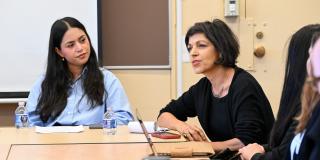
On October 9, to commemorate International Day of the Girl Child, the Institute of Global Politics (IGP) Women’s Initiative hosted a roundtable discussion with leading voices in policy, advocacy, and education to reflect on the erosion of Afghan women’s rights and explore pathways for international engagement and accountability.
The event was moderated by Jennifer Klein, codirector of the IGP Women’s Initiative and professor of professional practice at Columbia SIPA, and Rachel Vogelstein, codirector of the IGP Women’s Initiative, associate professor of professional practice, and Human Rights, Gender, and Equity concentration co-director, Columbia SIPA. Along with the Women’s Initiative, the roundtable was cosponsored by SIPA’s Human Rights, Gender, and Equity (HRGE) concentration and the Arnold A. Saltzman Institute of War and Peace Studies, and featured three panelists: Shabana Basij-Rasikh, cofounder and president of the School of Leadership, Afghanistan (SOLA) and Inaugural IGP Carnegie Distinguished Fellow; Rina Amiri, former US Special Envoy for Afghan Women, Girls, and Human Rights; and Khadija Ghanizada, a recent graduate of MIT’s Master in City Planning (MCP) program and member of the Afghan diaspora advocating for women’s rights and education.
Basij-Rasikh opened the discussion with a reflection on the resilience of Afghan women and girls living under Taliban rule. She described how hundreds of decrees have erased women from public life – restricting their access to schools, employment, and healthcare, and even removing books written by women from libraries. Despite these restrictions, she said, Afghan women and girls continue to resist.
Speaking virtually from Rwanda, where SOLA operates its boarding school for Afghan girls in exile, Basij-Rasikh shared first-hand accounts from her students, many of whom have not seen their families since 2021. “The darkness instilled by the Taliban will not sustain – girls remain defiant,” she said, noting that her students remain determined to study and lead. “Afghan women will not stop their fight to regain the most basic human rights.”
Basij-Rasikh urged the audience not to “look away from Afghanistan,” warning that silence risks normalizing a world where gender apartheid is tolerated. “In 2025, it is extremely dangerous for women everywhere to see an example of a society where it’s acceptable to ban women from academia and social life,” she said.
Drawing from her experience as US Special Envoy for Afghan Women, Girls, and Human Rights during the US withdrawal from Afghanistan, Amiri reflected on the failures of the international community to include women in peace and security strategies. She stressed that women’s rights must be viewed not as an “afterthought,” but as central to international security. “Human rights is not just a nice issue – it’s a strategic issue.”
Amiri recounted how Afghan women had warned of the Taliban’s resurgence long before Kabul’s fall, only to be dismissed. She described how her female sources witnessed the Taliban stripping Afghan women of their professional credentials and forcing some into marriage. “We avoid women’s worry to our own peril,” she said.
Amiri warned that global inaction risks legitimizing the Taliban’s repression. “Afghanistan can become the North Korea of the region, a region with four nuclear states in immediate proximity,” she cautioned.
Khadija Ghanizada, who grew up in Kabul before pursuing college and graduate school in the US, spoke about watching her country’s progress unravel. “As a young girl, I had hope. We believed Afghanistan was moving forward,” she said. ”Now, that hope has been replaced by fear and exile.”
Ghanizada criticized the global community’s response to the Taliban’s policies, saying “the international community continues to use soft language without showing any form of engagement.”
She urged the audience to see Afghanistan as a test of global resolve, rather than a failed state. “The world’s commitment to Afghan women will define how seriously we take equality and human rights everywhere,” she concluded.
Closing the event, Professor Vogelstein emphasized that the discussion was not only about Afghanistan, but about the future of women’s rights worldwide. The resilience of Afghan women reminds us that progress is never inevitable, it must be defended – again and again.