IGP Women’s Initiative Hosts Discussion on the Future of Human Rights in US Foreign Policy
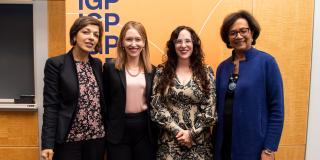
On March 12, the Institute of Global Politics (IGP) Women’s Initiative and the Columbia Law School Human Rights Institute cohosted a discussion on the future of human rights in US foreign policy. The event, cosponsored by the Human Rights, Gender, and Equity (HRGE) Concentration, featured insights from former U.S. government officials who previously shaped US policy on human rights.
Opening remarks from Rachel Vogelstein, director of the IGP Women’s Initiative and associate professor of professional practice at SIPA, set the stage for a conversation on strategies to protect and defend human rights across the globe amid rising violations and attacks on the human rights system.
Dr. Geeta Rao Gupta, cofounder and principal of the Alliance for Diplomacy and Justice and former US ambassador-at-large for global women's issues, explained that her ambassadorship was established because officials realized “women’s rights were seen as a cornerstone of US foreign policy.” Gupta noted her office’s top priorities included advancing women’s participation in peace and security, addressing gender-based violence, and promoting women’s economic empowerment. However, since the office’s closure, Gupta warned that the contemporary environment is increasingly challenging for global gender equality efforts.
Jessica Stern, co-president of The Alliance for Diplomacy and Justice and former US special envoy for LGBTQI+ persons, discussed how changes in US policy reverberate across the global human rights ecosystem. The United States, she noted, historically has played a major role in funding international organizations and initiatives addressing human rights, health, and humanitarian assistance. According to Stern, some groups lost funding for critical services almost overnight, forcing health clinics to scale back staff and limiting access to life-saving medications.
“These issues are sometimes treated as marginal concerns,” Stern said, referring to gender equality and LGBTQI+ rights. “But in reality, they are among the first areas targeted when broader democratic norms begin to erode.” She described attacks on diversity, equity, and gender policies as a “canary in the coal mine” for the health of democratic governance and the rule of law. By raising standards for human rights globally, she argued, countries strengthen their own international credibility and soft power.
Rina Amiri, cofounder and principal of The Alliance for Diplomacy and Justice and former US special envoy for Afghan women, girls, and human rights, stressed the importance of international coordination in defending women’s rights in Afghanistan. Following the Taliban’s return to power, she led US diplomatic efforts with partners across Muslim-majority countries to oppose restrictions on women’s rights. These initiatives often relied on public-private partnerships and collaboration with civil society organizations, many of which now have reduced capacity due to funding cuts.
Despite these challenges, Stern encouraged students to build alliances across political ideologies: “We can’t only speak to people who already agree with us,” she said. “We need to listen, expand our coalitions, and build a larger tent without compromising our values.”
Gupta urged audience members to rethink how international cooperation on gender equality might evolve. One possibility, she suggested, is expanding the role of subnational actors, pointing to the potential for local governments to collaborate across borders on shared human rights and equity initiatives.
Amiri emphasized that citizens themselves must play a greater role in sustaining democratic norms. Grassroots organizing can galvanize public attention and pressure governments to act. “Passivity has enabled the pace of disruption,” she warned, contributing to the erosion of democratic institutions. Thus, the future of human rights advocacy may depend on mobilizing people beyond formal institutions.
In closing remarks, Kelsey Jost-Creegan of the Columbia Law School Human Rights Institute urged participants to recognize that moments of rupture can also create opportunities for transformation. Jost-Creegan reminded audiences that, throughout history, “women have dared to dream in the face of human rights violations.”