IGP Women’s Initiative Hosts Book Talk with Mona Lena Krook
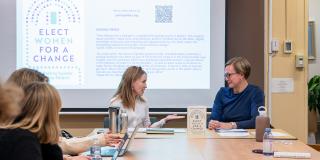
On February 26, the Women’s Initiative at the Institute of Global Politics (IGP) and Human Rights and Gender Equity (HRGE) concentration at SIPA hosted a book talk on the future of gender parity in politics with Mona Lena Krook, Distinguished Professor and chair of the Women and Politics PhD Program at Rutgers University and author of the new book, Elect Women for a Change: The Path to Gender Parity in Politics. Rachel Vogelstein, director of the IGP Women’s Initiative and associate professor of professional practice at SIPA, moderated the roundtable.
In discussing her new book, Krook explained why women’s political representation matters and what it would take to achieve authentic gender parity. She argued that equal participation in politics involves structural, cultural, and political change—not simply increasing the number of women in office. For instance, women politicians are often excluded from positions of influence and leadership and may face harassment or threats that limit their full participation.
Krook emphasized women’s participation in the decision-making process is a matter of justice. “Women shouldn’t need to prove their added value to participate in politics—they have the same right as men,” she said, noting that having women in office can broaden the issues being addressed and bring new perspectives to policymaking.
Krook measures gender parity in politics by analyzing three essential components: First, women and men should have equal access to participate in public debate. Second, parity requires equal access to positions of power, leadership, and influence. Third, parity must be inclusive, ensuring diversity across race, religion, and other backgrounds.
Following Krook’s presentation, Vogelstein moderated a discussion that touched on a variety of topics, including the barriers that hinder equal political representation and how to overcome them.
Krook highlighted a few key obstacles. In many contexts, women are still confined to the private domain of the household, making women’s political participation more difficult. Women are significantly less likely to consider themselves qualified for public office than men, she said. Finally, women who enter politics may face backlash and harassment intended to push them back into the “private domain,” and ascendancy to positions of power may also be blocked by party elites.
Krook identified several effective strategies to promote gender parity in politics. Training programs that equip women with the skills needed to run for public office can counteract patterns of socialization and encourage women’s participation in public discourse. Quotas are another valuable tool that can help to address gender divisions. To combat backlash, violence, and threats, Krook urged legal reforms, calling for tech companies to assume greater responsibility for online abuse and for legislators to criminalize threats of violence.
Krook concluded by pointing to the structural barriers that continue to impede equal political participation. “Women are systematically attacked and pushed out of public life,” she noted, stressing that meaningful progress will require reforms that make political institutions more welcoming and inclusive for women.