IGP Roundtable Explores Future of US-Iran Nuclear Diplomacy
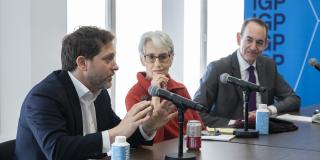
On April 1, the Institute of Global Politics (IGP) hosted “Is a New Nuclear Deal With Iran Possible?” — a roundtable conversation with IGP Carnegie Distinguished Fellows Ambassador Wendy Sherman, 21st Deputy Secretary of State, and Jon Finer, former Assistant to the President and Principal Deputy National Security Advisor and CGEP Distinguished Visiting Fellow. The conversation was moderated by Timothy Naftali, SIPA Senior Research Scholar, IGP Faculty Advisory Board member, and CNN presidential historian.
The discussion began by addressing the complex state of US-Iran relations, especially in light of the 2015 Joint Comprehensive Plan of Action (JCPOA) and its aftermath. Sherman, who played a central role in negotiating the JCPOA, reflected on the diplomatic challenges that led to the original agreement and the subsequent US withdrawal from the deal in 2018. “Iran today is a very different country,” she said, highlighting the social and political changes since the JCPOA’s inception.
Finer outlined the strategic choice faced by the Trump administration, given Iran was both closer to being able to produce a nuclear weapon if it chose, but also weaker than it had been in decades. This situation makes the status quo unsustainable, raising the odds of either a deal or a confrontation. Following the US withdrawal from the JCPOA in 2018, Iran had already begun scaling up its nuclear activities. The original deal had aimed to limit key aspects of Iran’s nuclear program, including the number and advancement of centrifuges, enrichment facilities, and uranium stockpiles. However, after the US pulled out, Iran ceased adhering to these restrictions, significantly shortening the timeline for Iran to produce enough material for a nuclear bomb. Finer also noted that Iran’s regional strategic position has now been weakened, with its proxies Hamas and Hezbollah weakened, with Russia preoccupied by the war in Ukraine and Syria in transition after the ousting of Bashar al-Assad. These shifts could make Iran more inclined to return to the negotiating table with the Trump administration, Finer said.
Both speakers acknowledged the difficulty of rebuilding diplomatic momentum, especially given the domestic political challenges in Washington and Tehran.
Naftali asked about the feasibility of returning to the agreement given the current geopolitical climate. Ambassador Sherman said that while a full return to the JCPOA seems unlikely, smaller, incremental agreements could be possible, focusing on limiting and increasing transparency about Iran’s nuclear advancements.
A student participant asked how regional actors, particularly Israel and Gulf states, influence US policy toward Iran. Finer explained that the perspectives of regional partners are a critical consideration, noting that “security concerns from partners in the region inevitably shape our policy decisions.” He added that recent normalization agreements between Israel and several Arab states also factor into US calculations.
Another attendee asked panelists about the role of Iran’s domestic politics. Ambassador Sherman acknowledged that the “hardline consolidation of power in Tehran presents real obstacles to diplomacy.” She also underscored the importance of understanding Iran’s internal pressures when assessing the prospects for negotiation.
Both Finer and Sherman concluded by emphasizing that while a new deal is uncertain, ongoing diplomatic engagement remains essential to managing the risks associated with Iran’s nuclear program.