IGP Hosts Workshop on Generative AI in India and Its Impact on Democracy
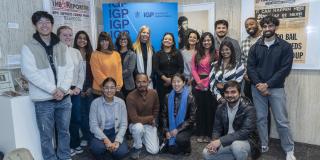
On April 21, Professors Tamar Mitts and Rumela Sen hosted a workshop to help launch a new report on the frontier of AI regulation in India. As part of an IGP faculty grant-funded project on the impact of generative AI on democracy, the workshop brought together students from Columbia SIPA and the Master of Science in Data Science program to consider how countries regulate AI and compare the institutional constraints shaping the use of generative AI in political communications.
Tamar Mitts, associate professor of international and public affairs and IGP Affiliated Faculty member, and Rumela Sen, a lecturer at SIPA and director of the Master of International Affairs (MIA) program, introduced the discussion by unpacking the project’s motives, initial findings, and future directions. On the project’s motivations, Sen said, “We were both very interested in how political communications worked in a diverse democracy like India, where the information environment is already very fragile. In that environment, what would deepfakes do to people’s trust in democracy when that trust is already fragile?”
The workshop opened with comparative presentations on global AI governance.
Sevastian Sanchez MIA ’27 analyzed Brazil’s approach, discussing the country’s policies surrounding electoral integrity and deepfakes – TSE Resolution No. 23.732 – and the Brazil AI Act, the country’s first comprehensive national AI bill. Across both regulations, Sanchez noted the presence of vague legal definitions, such as defining terms like ‘manipulation,’ which weaken the law’s enforcement capacity. Jennifer Ilanit Gibli MPA ’26 and Yanling Li MPA ’27 examined the European Union’s rights-based framework, anchored in the Digital Services Act, AI Act, and GDPR.
Sarah Mathew MPA ’26 and Andy Kim MS ’26 discussed the United States’ fragmented, state-driven approach to AI governance in the absence of comprehensive federal legislation. Sarah O'Connell MIA ’26 and Premika PoSaw MPA ’26 presented China’s state-centric model, emphasizing its focus on public order and national security, as well as emerging concerns around agentic AI’s impact on the country’s booming e-commerce industry. Shruti Shetty MS ’26 and Shreya Vishwanath Shetty MS ’26 concluded by describing India’s adaptive approach, which integrates AI into existing legal frameworks rather than relying on a standalone statute.
The workshop then shifted its focus inward, diving into India’s regulatory environment.
Shubham Pareek MS ’26 detailed how political parties are deploying AI in campaigns, from real-time translation tools to voice cloning. He also highlighted growing concerns around manipulated content, including deepfakes of deceased leaders and misleading campaign media, noting that existing safeguards, such as English-language watermarks, often fail to reach target audiences.
A second panel, featuring Bharat Nayak MPA ’27, Sana Mittar MPA ’27, and Kratima Divakar MPA ’27, examined India’s fragmented institutional landscape. They described a distributed governance model spanning multiple agencies, constrained by constitutional protections such as privacy, free expression, and equality, and shaped by legal tests like proportionality and disparate impact.
The final panel, led by Shruti Das MPA ’26, Varun Thotli MIA ’26, and Arushi Sharma MPA ’27, traced the evolution of India’s AI governance. Early efforts between 2018 and 2021 were largely exploratory and non-binding, while the post-2022 period – marked by the rise of generative AI – introduced more targeted interventions, including content moderation rules, GPU regulations, and stricter takedown requirements.
The workshop highlighted gaps in India’s institutional coordination, regulatory clarity, and democratic safeguards. As generative AI continues to evolve, participants emphasized that the challenge ahead will be ensuring that regulatory efforts align with principles of accountability, transparency, and public trust. The forthcoming report aims to contribute to the ongoing conversation by mapping a path forward for AI governance in one of the world’s most complex and consequential democratic contexts.