IGP Hosts Student Roundtable with Ha’aretz Editor Aluf Benn
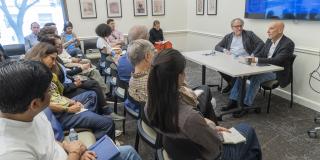
On September 12, the Institute of Global Politics (IGP) hosted Aluf Benn, longtime editor-in-chief of Ha’aretz, Israel’s leading left-leaning newspaper, for a timely discussion on the current state of Israeli politics. For over a decade, Benn has led analysis of Israel’s political, security, and ideological debates. He has chronicled the country’s rightward drift while offering sharp insights into the challenges facing liberal Zionism and the future of Israeli democracy.
The event was moderated by Nicholas Lemann, dean emeritus of Columbia Journalism School, Joseph Pulitzer II and Edith Pulitzer Moore Professor of Journalism, and director of Columbia Global Reports.
The roundtable opened with an overview of Israeli politics. Benn focused on how Prime Minister Benjamin Netanyahu has systematically eroded institutional guardrails in Israeli society – notably the judiciary and the military – both of which have historically served as moderating forces.
Regarding the judiciary, Benn addressed the controversial reforms pursued by the Netanyahu government and the mass protests they triggered in 2023. He acknowledged that while the protesters effectively stalled parts of the reform package, they ultimately failed to prevent significant changes to judicial independence.
Benn also discussed the role of the Israeli military as a balancing force and important guardrail in politics. Israel’s mandatory conscription service, he explained, has transformed the military into an inclusive institution, which contributed to its role as a moderating political actor. However, according to Benn, the aftermath of the October 7 attacks – and the perceived failure of Israel’s security services – allowed Netanyahu to sideline the military’s influence and consolidate power to advance his political agenda.
Aside from the subversion of Israel’s political guardrails, the discussion touched on a range of issues shaping Israeli politics, including the draft, the longevity of Netanyahu’s coalition, and the state of press freedom.
Benn highlighted the conscription of Haredi Jews as one of the most contentious current debates. In 2024, Israel's Supreme Court unanimously ruled that Haredi Jews were eligible for compulsory service, ending nearly eight decades of exemption. The ruling has divided the coalition, which Netanyahu has been effective at exploiting. “Netanyahu is a master at splitting the opposition,” Benn noted.
Concerning the stability of Netanyahu’s coalition government, Benn remarked that “the coalition is unstable, but ideologically cohesive,” underscoring the paradox that holds the current administration together despite internal tensions.
Turning to the media landscape, Benn expressed concern over the weakening of press freedom in Israel. He pointed to the absence of independent reporting from Gaza, which he said contributes to a distorted public perception of the ongoing conflict. A dynamic that he claims is shaping public opinion about the ongoing war as restrained, portraying Israel’s actions as defensible and Palestinians as terrorists. “The idea to treat Palestinians as human beings is alien to most Israeli citizens,” Benn said, emphasizing how dominant narratives frame Israel’s actions as defensible while depicting Palestinians as terrorists. “The sense is that they had it coming,” he said.
Following the discussion, students and faculty took the opportunity to ask questions. While many focused on Israel’s foreign relations and Palestine, others addressed the future of the free press and domestic politics.
In response to a question about how public opinion shapes Israeli politics, Benn reiterated its importance, but also cautioned that polling methodologies often shape public narratives. Referencing recent polls concerning the Gaza conflict, he argued that support for the war is likely stronger than polls suggest due to the way questions are framed.
Benn concluded the discussion by reflecting on Netanyahu’s longevity, citing successful domestic and economic policies as the key to his continued popular support.