IGP Hosts Introductory Roundtable with Dr. Salam Fayyad on the Future of Palestine
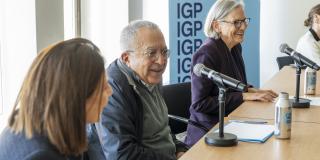
On March 10, the Institute of Global Politics (IGP) welcomed IGP Carnegie Distinguished Fellow Dr. Salam Fayyad, an economist and former prime minister of the Palestinian Authority. Drawing on his experience across academia, politics, and multilateral institutions, Fayyad reflected on the challenges of building effective institutions under occupation and the long-term foundations required for a viable Palestinian state. The roundtable was moderated by Dean Emerita Lisa Anderson, James T. Shotwell Professor of International Relations.
Fayyad discussed his work after leaving public office, including starting the non-profit, Future for Palestine. He designed the organization to continue his development work outside government, focusing on providing basic services to marginalized communities. Fayyad highlighted investments in renewable energy and water wells as key achievements in improving the lives of ordinary Palestinians. Investments in development, he emphasized, are important for future political gains. Access to electricity, water, education, and economic opportunity make communities more resilient, he noted.
When asked about the future of the two-state solution, Fayyad acknowledged growing skepticism, but cautioned against abandoning the framework altogether. Discarding the two-state paradigm, he argued, does not automatically produce a viable alternative.
Fayyad also emphasized that any viable political future for Palestine must include Gaza, describing the political separation between Gaza and the West Bank as an “Achilles’ heel” for the Palestinian cause. He suggested that a transitional governing framework linked to the Palestinian Authority, and the potential for elections within several years, could help restore political accountability. In the meantime, the most urgent priority is enabling Palestinians to remain on their land and sustain their communities, he argued.
Fayyad stressed that political progress requires a long-term strategy centered on governance and institutional capacity, and that agreeing on statehood before building the institutions capable of governing effectively would be unsustainable. He cautioned against the search for quick political fixes over long-term solutions.
The exchange then shifted to the role of international law and foreign investments. While Fayyad expressed support for the rules-based international system, he noted that international law alone cannot deliver political outcomes and that Palestinians must actively advocate for their interests and demonstrate credible governance to maintain international engagement.
In closing, Fayyad reflected on international recognition of Palestinian statehood and regional diplomacy. While welcoming international support, he cautioned that symbolic gestures alone cannot substitute for meaningful political progress.