IGP Hosts Conversation on US Intelligence Community’s Evolution
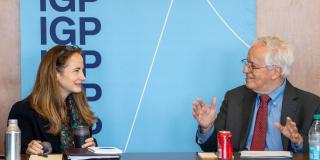
On October 22, the Institute of Global Politics (IGP) hosted Avril D. Haines, former US Director of National Intelligence and IGP Carnegie Distinguished Fellow, for a wide-ranging conversation with Peter Clement, adjunct senior research scholar at Columbia’s Arnold A. Saltzman Institute of War and Peace Studies and adjunct professor at SIPA. Their discussion addressed the evolving role of the US Intelligence Community, declassification of intelligence, and how intelligence shapes both domestic and global policy.
Haines opened by talking about her time in government and the US strategy of “strategic unclassification” during the decisive months preceding Russia’s full-scale invasion of Ukraine in February 2022. Haines described how Washington worked to convince skeptical European allies of Russian President Vladimir Putin’s intentions.
“Europe didn’t believe us,” she recalled, adding that “many thought the US was trying to provoke Putin.” According to Haines, some governments feared that revealing intelligence would trigger economic anxiety or undermine diplomacy.
To build credibility and deter Russian aggression, the US selectively declassified satellite images, analysis, and assessments, setting a new precedent for intelligence diplomacy, Haines said. The effort ultimately helped convince and build trust among European allies while countering Russian disinformation. Sharing information also enabled the US to foster relationships and better coordination with its allies, noted Haines, underscoring potential future incentives for the US Intelligence Community to lean into publishing information.
Haines acknowledged that declassification always carries risks. Intelligence comes from myriad sources, including human intelligence from people who risk their lives to pass on information. During the Ukraine crisis, for example, the US Intelligence Community developed new structures to manage those risks and to balance secrecy with public trust. Haines also reflected on how the nature of intelligence has shifted, with open-source information often complementing – sometimes supplanting – human intelligence.
Later in the conversation, Haines opened up about her experience as an intelligence professional and policymaker, someone who has produced and consumed necessary intelligence. She stressed the importance of distinguishing between the two roles. Preserving policy neutrality when working as an intelligence professional is paramount, she warned, because without it, policymakers could doubt your information.
Looking back at why some allies misjudged Russia’s intentions in 2022, Haines highlighted diverging assumptions. In her experience, most Europeans couldn’t understand why Putin would launch a full-scale invasion, arguing that it would be too costly for him and Russia. Haines concluded that as information becomes more open and globalized, the US Intelligence Community’s challenge is to adapt without losing its core mission.