IGP Hosts Conversation with Jean-Noël Barrot, French Minister for Europe and Foreign Affairs
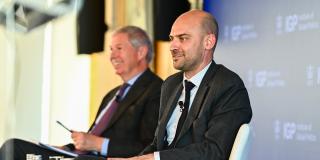
On April 27, the Institute of Global Politics (IGP) hosted Jean-Noël Barrot, French minister for Europe and foreign affairs, to address the role of Europe in fostering international cooperation and stability in the 21st century. The event, cosponsored by the Alliance Program, the European Institute, and the Arnold A. Saltzman Institute of War and Peace Studies, was moderated by Jean-Marie Guéhenno, professor of practice and director of SIPA’s Kent Global Leadership Program on Conflict Resolution.
In his remarks, Barrot situated today’s geopolitical tensions within a longer historical trajectory, arguing that the post-Cold War era fostered confidence in a Western-led model, anchored in multilateralism, market economies, and democratic governance. Yet, he noted that this system was largely designed by and for the West, and no longer reflects a transformed global landscape. Barrot pointed to China’s strategic use of economic and technological tools, including supply chain dependencies, to expand its global influence.
Grounded in the US-China rivalry, Barrot added that “Europe can dramatically change this geopolitical equation.” He advanced the case for a European “third path,” based on national sovereignty and respect for international law. Rejecting narratives of continental decline, he emphasized Europe’s historical resilience: “European civilization is not fragile; it is a civilization of the mind, forged over two millennia through conflict and reconciliation, through failure and renewal,” underscoring Europe’s capacity to adapt and lead.
Barrot outlined three pillars for Europe’s role moving forward: security, prosperity, and democracy. On defense, he highlighted growing coordination across Europe and continued support for Ukraine, including preparations for long-term security guarantees. Economically, he emphasized efforts to shield European markets from unfair competition while investing in strategic sectors such as artificial intelligence, quantum computing, and green technology. On governance, he pointed to initiatives to counter disinformation, including plans for a European Center for Democratic Resilience and stronger regulation of social media platforms.
While acknowledging the rise of nationalist politics and the perceived sluggishness of European institutions, Barrot pushed back on the idea that structural constraints are the primary obstacle. Instead, he argued that Europe has already demonstrated, particularly during moments like the COVID-19 crisis, its capacity to act decisively when political will aligns – evidence that institutional frameworks can be mobilized effectively.
On technology governance, Barrot distinguished between different regulatory imperatives. He called for stronger accountability measures for social media platforms, particularly to address disinformation and safeguard democratic processes. At the same time, he cautioned against overregulating generative AI at an early stage, arguing that Europe must preserve space for innovation if it hopes to remain competitive. “As long as we have a chance to forge our own generative AI,” he noted, “we must give as much space as possible to innovation.”