IGP Hosts 2025-2026 Student Circle Luncheon
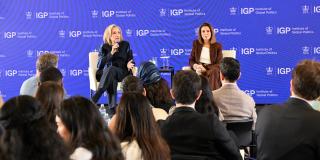
On October 29, the Institute of Global Politics (IGP) hosted a student roundtable with Secretary Hillary Rodham Clinton, IGP Faculty Advisory Board chair and professor of international and public affairs, and Keren Yarhi-Milo, SIPA dean and Adlai E. Stevenson Professor of International Relations. The event welcomed the 2025-2026 IGP Student Circle cohort – a group of approximately 100 scholars from across the University – with an exchange on foreign policy, multilateralism, and the future of democratic institutions.
Opening the session, Dean Yarhi-Milo congratulated students on their acceptance to the Student Circle, describing the group as a key part of IGP’s mission since its founding in 2023. “Our vision is to engage students directly with leaders and senior practitioners,” she said, emphasizing that students play a central role in IGP’s work: “The [IGP] fellows come because of the students.”
Secretary Clinton echoed Yarhi-Milo’s sentiments, telling participants, “We see you as partners,” and stressing the importance of student engagement in shaping global policy conversations.
When asked how students can best contribute to IGP’s mission, Clinton underscored the value of generational insight. “Students have a perspective of a younger generation,” she said, adding that “for us, that’s the most important.” She stressed that student-led initiatives and feedback are critical to IGP’s evolving agenda.
The discussion quickly turned to pressing geopolitical issues, with students participating in a Q&A session. In a question about the state of international institutions, one student raised concerns about the US adopting an “à la carte” approach to multilateralism. Clinton acknowledged the challenges facing multilateral institutions, including paralysis of the UN Security Council, and called for major reform, stressing the enduring importance of international organizations.
“The UN needs some tough love,” she said. “It does some things very well, like global coordination on air traffic and communication – but its high-profile work is often paralyzed.” She argued for reform rather than rejection of multilateral institutions, saying “we have to do a better job making them work better.”
Addressing a question about domestic governance, Clinton reflected on what one student described as a “post-constitutional” political climate in the US. She warned of the dangers posed by leaders who disregard institutional checks and balances.
“Our legal system is vulnerable to leaders who don’t intend to be held accountable,” she said. “When you have a Congress that doesn’t care about itself and a Supreme Court that seeks to appease the executive, the only remedy left is to vote such regimes out,” she concluded.
The discussion ended on a personal note, with Clinton offering advice to students pursuing careers in public service. Reflecting on her decades in politics and diplomacy, she urged students to remain resilient: “Believe in yourself – and have a group around you that believes in you.”