IGP Convening Addresses Complex Geopolitical Chessboard
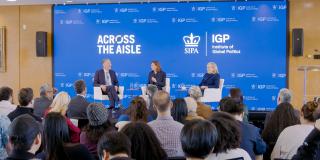
On November 12, the Institute of Global Politics (IGP) convened leading diplomats and scholars for a wide-ranging examination of today’s shifting global landscape. The event, titled “The Geopolitical Chessboard: Implications of the Current Global Ferment,” culminated in the latest installment of IGP’s Across the Aisle series: a conversation between Secretary Hillary Rodham Clinton, professor of international and public affairs and IGP faculty advisory board chair at SIPA, and Secretary Mike Pompeo, IGP Carnegie Distinguished Fellow.
The first panel featured a group of seasoned policymakers discussing the state of world affairs, touching on Russia, China, and emerging regional actors. The panel included Victoria Nuland, Shelby Cullom Davis Professor in the Practice of International Diplomacy, director of the International Fellows Program at SIPA, a US diplomat for more than three decades, and IGP Faculty Advisory Board member; Julian Gewirtz, IGP senior research scholar and former White House National Security Council senior director for China and Taiwan affairs; and Martin Kimani, President of The Africa Center, former IGP Carnegie Distinguished Fellow, and former Permanent Representative of Kenya to the UN. Bianna Golodryga, a CNN anchor and global affairs analyst, moderated the conversation.
The opening conversation focused on the challenges posed by Russia and China. Nuland, who most recently served as Under Secretary of State for Political Affairs and Acting Deputy Secretary of State under President Biden, began by distinguishing between diverging Russian and Chinese approaches to challenging the current world order. She discussed Russia’s strategy of direct confrontation in comparison to China “working hard to change [the world order] from the inside.” On China, the panel examined how the US should manage the strategic challenge posed by Beijing. Gewirtz, who served in multiple senior policymaking roles during the Biden administration, started the conversation by underscoring Washington’s decisive asset in its deterrence against China: its vast network of allies. He warned of the risks associated with a foreign policy that could undermine US alliances.
Moving to Africa, Kimani highlighted demographic and political shifts that he said will redefine global norms. The African continent has the youngest population in the world, positioning it to exert significant influence on global institutions and culture. Yet despite these opportunities, young people across the continent remain frustrated with the current global governance structures that fail to reflect their priorities. Both Kimani and Nuland stressed the need for Western nations to deepen engagement on the continent to help harness its potential – starting with addressing the ongoing tragedies in Sudan.
The panelists also discussed Europe’s response to Russia’s invasion of Ukraine. Nuland credited European governments with stepping up to support Ukraine’s security. Kimani noted that the war has consumed “an intense amount of attention,” reducing the West’s global engagement as China expands its diplomatic and economic reach, particularly in Africa.
The second half of the event featured a wide-ranging Across the Aisle conversation between two former US Secretaries of State, introduced by Columbia’s Acting President Claire Shipman and moderated by SIPA Dean Keren Yarhi-Milo.
On US credibility, both speakers emphasized its indispensable role as a strategic asset, particularly regarding the long-term threat posed by China. Pompeo argued that credibility hinges on consistent resolve. While reaffirming Washington’s centrality to world affairs, he warned that the US must retain focus on its strategic objectives related to China. Clinton underscored the importance of undeterred support for Ukraine. “Ukraine is a proxy for everything we believe in and care about,” she said. Beijing, she argued, views the ongoing war as a test for Western resolve, highlighting its profound importance for the future balance of world power. Pompeo agreed, noting, “Xi Jinping is watching very closely how the West is responding to this challenge from Vladimir Putin. I don't think there's any doubt about that. I think that's absolutely essential. And as for spheres of influence, I want to influence every sphere.”
The conversation then turned to the role of aid, international institutions, and American soft power. Starting with the US Agency for International Development (USAID), Clinton expressed concern about risks posed by future pandemics or other global shocks in the absence of US development aid. She described the dismantling of USAID as an “unforced error,” noting that “something will have to replace it” because “diseases don't respect global boundaries.” Pompeo, affirming the importance of a global US presence, stated that “American soft power is absolutely critical to achieving our end objectives,” and acknowledged that the US, including the first Trump administration of which he was a part, has not done enough on this front. Yet he remained skeptical of USAID and described the UN as “no longer fit for purpose,” stressing the need for widespread reform to ensure a return to its original charters and intent.
The discussion concluded with a series of rapid-fire questions on pressing global flashpoints. Starting with Venezuela, Clinton criticized the Trump administration’s stated policy of using force to curb the flow of illegal drugs into America. Pompeo emphasized President Trump’s commitment to protecting US sovereignty by ending the “tragedy” of illegal immigration. Turning to the Middle East, Pompeo criticized Iran’s destabilizing activities while stressing the importance of engaging all regional actors to make gains. Clinton highlighted the challenges of dissolving Hamas, noting the group’s complex web of regional allies. A durable solution, she argued, requires establishing a new Palestinian government or effecting change within the Palestinian Authority.
To conclude the event, both secretaries shared advice for students entering careers in public service. Pompeo encouraged them to “separate the signal from the noise” and always maintain clarity about their mission. Clinton urged students to define and cement their own values, rather than being swayed by social media or adhering to the views of a single leader, and to ensure those values “serve as [their] North Star” throughout the entirety of their life and career. She closed the event encouraging students to engage with those who are different from them, “from different places, [with] different ideas, [with] different experiences,” underscoring the necessity and value of such conversations, including that between her and Secretary Pompeo in this program, in broadening one’s understanding of themselves and the world.