Image
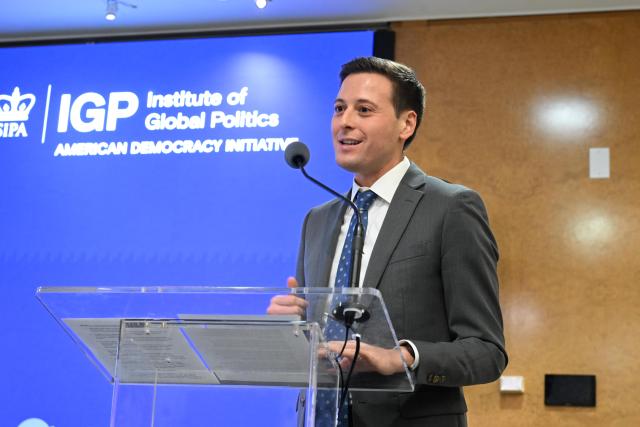
On November 10, Columbia SIPA’s Institute of Global Politics (IGP) and the Washington Center for Equitable Growth hosted a discussion on the role of economic policy in generating populist support. Building on a recent essay series and multistakeholder convening, the event, cosponsored by the Columbia Center for Political Economy, marked the inaugural public program of IGP’s American Democracy Initiative.
Opening remarks from Alexander Hertel-Fernandez, director of IGP’s American Democracy Initiative and Herbert Lehman Professor of Government, and Shayna Strom, president and CEO of the Washington Center for Equitable Growth, set the stage for two panels examining neoliberal policymaking, the delivery of economic promises, and the labor movement’s role in representing workers.
The first panel, “Rebuilding Trust in Government for Equitable Economic Growth,” brought together scholars and officials to discuss how economic policy shapes public trust in a democracy.
Nobel Prize laureate in economics and Columbia professor Joseph Stiglitz defined populist leaders as individuals making “promises that are untethered to economic constraints,” citing neoliberal policies like trickle-down economics as failed attempts to boost middle-class prosperity. Such failures, he argued, fueled voter discontent and backlash.
Sheri Berman, Barnard College professor of political science, linked the rise of populism to the 2008 financial crisis, noting that the US is part of a broader global trend: “The United States, in a way, is a follower,” she said, “because we’ve seen right-wing populism on the right in Europe for quite some time.” Berman added that many populists focus less on economic hardship and more on cultural grievances, which often underpin discriminatory policymaking.
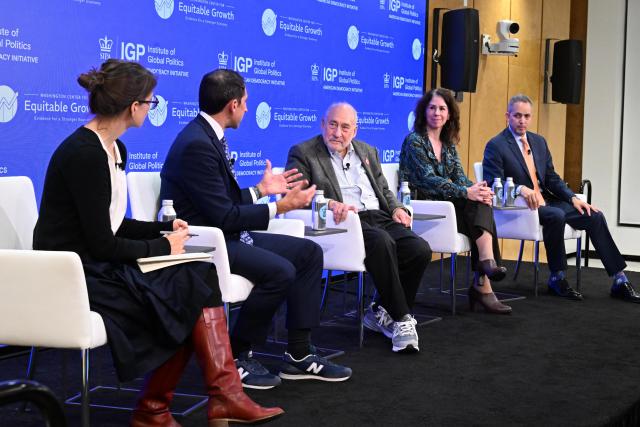
Reflecting on the Biden administration, Don Graves, former US Deputy Secretary of Commerce from 2021 to 2025, emphasized the challenge of communicating economic policies effectively. “It’s not only what [economic] policies you’re delivering; it’s how, where, and when you deliver them,” he said, adding that “it became a challenge for us, as an administration, to move fast enough.” Graves suggested that communicating the role of institutions in fostering inclusive growth and collaborating with local governments could help advance economic opportunities.
Matt Tuerk, mayor of Allentown, Pennsylvania, built on this point by highlighting local government’s role in delivering economic prosperity. “When people are looking for their government, it’s easiest to find it on the street in front of their house,” he said. Tuerk stressed the importance of direct community investment, saying that “when you give people the resources they need, they feel seen.”
The second panel, “Bipartisan Solutions to Achieve Prosperity for Working-Class Americans,” focused on the labor movement and strengthening worker representation.
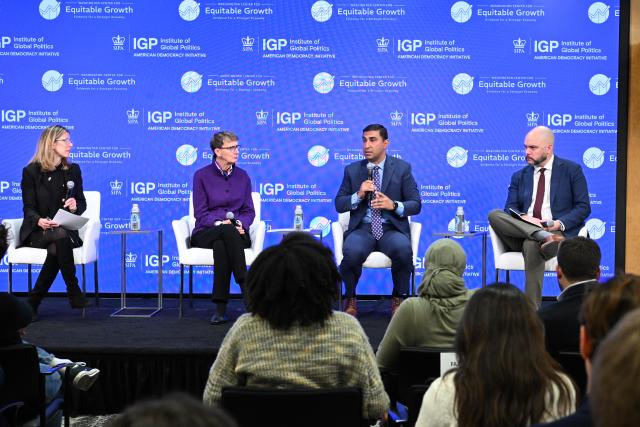
“We have gotten detached from the working class as a center-left movement,” said Faiz Shakir, founder and executive director of More Perfect Union. Shakir argued that “the makers of our economy – the workers – don’t have power; the takers have the power,” framing labor advocacy as a fight for political representation.
Chris Griswold, policy director of American Compass, similarly noted that political parties are unresponsive to the labor movement. Grisworld recommended “breaking the assumption that collaboration between corporations and workers is impossible,” citing growing political support for placing workers on corporate boards. Griswold also advocated for depoliticizing labor unions to expand their appeal to a broader base of workers.
Beyond pragmatic considerations, the labor movement’s strength also stemmed from bottom-up advocacy. Mary Kay Henry, former president of the Service Employees International Union and IGP Carnegie Distinguished Fellow, highlighted the grassroots approach in the Fight for $15 campaign to raise the minimum wage. As one of the movement’s architects, Henry traced its success to worker-driven demands, noting that “it was 200 workers in the Bronx who came up with $15 [...] That demand and movement created policy.” Looking ahead, Henry emphasized the importance of continuing this momentum by advancing worker-led initiatives at the local and state levels to influence national labor policy.
Together, the panels concluded that rebuilding economic trust is essential to addressing the roots of populism. By combining policy innovation with grassroots advocacy, participants highlighted a shared goal: restoring faith in institutions through inclusive economic growth that empowers working people.