Former Foreign Minister of Sweden Margot Wallström Weighs in on Gender Equality and Foreign Policy
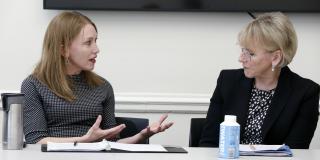
On May 1, Margot Wallström, Kent Visiting Professor and former Foreign Minister of Sweden, joined the Institute of Global Politics (IGP) Women’s Initiative Director Rachel Vogelstein for a roundtable on feminist foreign policy. Cosponsored by the Kent Global Leadership Program on Conflict Resolution, the event brought students and faculty together to discuss prospects for gender equality amidst a concerning global trend: backsliding on gender equality gains.
Wallström reflected on her 2014 decision to embrace a feminist foreign policy, which she said was, at its core, about rights, representation, and resources. Much of her work was inspired by survivors of sexual violence. “I carry that with me,” she said, “I have a heavier heart but also the inspiration to bring it into the work of any foreign ministry.” Survivors’ strength and desire to participate in public life shaped her vision.
“There will never be sustainable peace … unless women are involved fully and can use their full potential,” Wallström added, invoking UN Security Council Resolution 1325, which in 2000 recognized war’s unique impact on women.
Wallström emphasized that feminist foreign policy must be rooted in actionable goals. “It is neither a revolution nor a slogan,” she said. As Foreign Minister of Sweden, she prioritized issues that she felt she could directly impact, such as curbing child marriage and female genital mutilation worldwide, improving women’s representation, and promoting paid leave. Wallström said her ultimate goal was never to focus on identity but to inspire changes in mindset and unlock new opportunities. “We have to move toward seeing each other as human beings, with full universal rights,” she urged.
For now, momentum has stalled, both speakers noted. In 2022, Sweden dropped its feminist foreign policy but promised that it would continue to pursue program objectives. In practice, however, it reallocated resources away from feminist foreign policy objectives and made countering migration a priority, Wallström observed. Vogelstein empathized, noting that President Donald Trump had dissolved the White House Gender Policy Council, which President Joe Biden had formed to advance gender equality and equity in U.S. domestic and foreign policy.
Their conversation also touched on broader trends in democratic backsliding. “Women’s rights are associated with democratic participation,” Wallström said. “The repression of these rights is associated with authoritarianism.” She stressed the need for gender advocates to join forces and fight the changes of the moment by engaging in community organizing, participating in electoral processes, and, if necessary, sharing their perspectives in letters to the editor.
When a student asked how best to navigate patriarchal bureaucracies, Wallström underscored the importance of ensuring that the program was relevant. “The agenda must be translated,” she said. The fourteen states that have embraced a feminist foreign policy must tailor it to their particular context, then ensure that their diplomatic corps embodies its calling.
In response to a separate student question about how to involve men, Wallström recounted how she had piloted a diplomatic training on feminist foreign policy during her tenure as foreign minister. It became difficult for subsequent governments to fully eradicate feminist foreign policy, as both male and female diplomats had come to see the world through this lens.
Walström and Vogelstein expressed pride in their work’s impact but cautioned that there were still gaps in implementation, resources, and services. “There is no doubt that there is a lot of work to do,” Vogelstein reminded students.