Documentary About Qaddafi’s Libya Screened at Columbia SIPA
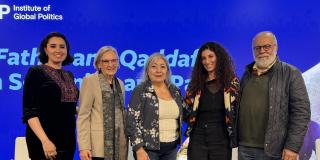
On April 22, Columbia SIPA hosted Syrian-American filmmaker Jihan K for a screening of her documentary My Father and Qaddafi, followed by a panel discussion that explored the film’s emotional and political dimensions. Moderated by SIPA Dean Emerita Lisa Anderson, the event brought together Jihan K, her mother Baha Al Omary, and historian Hamid Dabashi for a reflection on identity, memory, and Libya’s political past under Muammar al-Qaddafi.
The film traces Jihan K’s effort to understand the disappearance of her father, Mansur Rashid Kikhia, a former Libyan foreign minister, United Nations ambassador, and human rights lawyer. He defected from Qaddafi’s regime and became a leading figure in the opposition before vanishing in Cairo in 1993. His fate remained unknown for nearly two decades, until his body was discovered in a freezer near Qaddafi’s palace after the regime’s fall.
Blending personal narrative with historical inquiry, the documentary unfolds as both a daughter’s search for a missing parent and a broader reckoning with Libya’s past, as Jihan K pieces together fragments of a life she barely knew while grappling with what it meant to inherit a history shaped by violence, exile, and silence.
During the discussion, Dabashi, who is the Hagop Kevorkian Professor of Iranian Studies and Comparative Literature at Columbia, described the film as “an absolutely masterful crafting of a daughter’s love letter to her father,” emphasizing its layered storytelling. He noted that its scope extends beyond the personal: “The search is not just [an] individual daughter looking for her dad… it’s also for her homeland, for Libya.” Dabashi argued that the film’s political significance lies in its portrayal of Libya, which resists reduction to a single political narrative and instead reveals “the multiplicity and cosmopolitan character of a Libya… systematically erased” when the country is viewed only through the lens of [Qaddafi’s] dictatorship.
The tension between personal narrative and national history runs throughout the film. Under Qaddafi’s 42-year rule, Libya experienced dramatic transformations: oil wealth funded programs that improved living standards, but political repression, violence, and systemic human rights violations defined public life. As Jihan K noted during the discussion, cases like her father’s were not unique, but part of a pattern of Libyan dissidents being abducted abroad.
Beyond its examination of Libya under Qaddafi’s regime, the documentary also explores themes of family, resilience, and identity. Jihan K documents the story of her mother, Baha Al Omary, a Syrian-American artist, as she leads her search for Kikhia. At one point, she meets Qaddafi in the middle of the night in the Libyan desert in an attempt to negotiate her husband’s release. “We have a glimpse of a love story between a Syrian lady and Libyan gentleman,” Dabashi said, noting that the film centers on human relationships within the era’s political landscape.
The conversation turned to a central question in the film: What does it mean to be Libyan “without Qaddafi, without politics, without fear?” The filmmaker said she interviewed more than 60 people while making the documentary, many of them Libyans of her father’s generation, and found that even those deeply rooted in the country struggled to answer that question. One older man, she recalled, tried to reassure her about her mixed background and estrangement from the country. “Don’t worry,” he said. “I’m Libyan. My mother’s Libyan, my father’s Libyan. I was born in Libya. I speak the language… and even I don’t know what it means to be Libyan.” The admission, she said, felt like a release: “I felt this huge weight lifted.”
She described that uncertainty as reflecting a broader rupture in collective national identity. “All of us are sharing this loss of this identity,” she said. “What I can’t rationalize is that Qaddafi would steal my identity, my past, my understanding of my own family.” The film, she added, becomes an act of reconstruction, assembling what has been fragmented or erased.
The discussion also touched on the psychological impact his dictatorship had on Libyans’ personal lives. Reflecting on her own childhood, Jihan K described Qaddafi as an omnipresent force. “He’s so powerful that he’s in my thoughts, he’s in my dreams, he almost operates like a demigod,” she said. “He had a puppeteering hand in my life.” She explained how his power extended far beyond politics, shaping her basic understanding of reality itself. As a child, she struggled with the concept of her father’s disappearance, unable to say he was dead because that truth had never been confirmed. That ambiguity, she said, created a suspended state between belief and doubt, engineered by the regime.
“That’s the grip of tyranny – it's so deep, it affects your rational mind,” she said of the experience. “It's deeply disorienting, constantly.” Qaddafi’s reach, she added, was so total that it intruded into the most intimate spaces, influencing how she understood family, loss, and even language. “He had a hand in all of that,” she said, speaking about the confusion and guilt she carried as a child. She noted that dictators can “kill our fathers and replace them,” becoming a warped authority figure in their place. The result is not just political control but a form of psychological domination that can linger long after a regime has fallen.