Columbia IGP Women’s Initiative Launches New Report, “Accelerating Efforts to End Child Marriage,” at a Global Convening
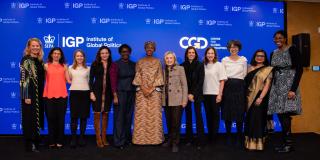
For H.E. Dr. Fatima Maada Bio, first lady of Sierra Leone, the fight to end child marriage is deeply personal. At 12 years old, she was told that the older man she had called “uncle” all her life would become her husband. Decades later, Bio has used her experience to become a leading international voice against child marriage, helping enact a landmark law criminalizing the practice in Sierra Leone in 2024.
Bio shared her story during a forum on March 4 at Columbia University, where policymakers, international development leaders, and advocates gathered to discuss strategies for combatting child marriage worldwide. The event, cohosted by the Institute of Global Politics Women’s Initiative and the Center for Global Development, also marked the release of a new report, Accelerating Efforts to End Child Marriage, which was commissioned by founder of Lean In, Sheryl Sandberg, and coauthored by Professors Rachel Vogelstein and Jennifer Klein, who direct the Women’s Initiative at Columbia SIPA’s Institute of Global Politics. The new report includes an analysis of the economic cost of inaction on child marriage prepared by the Center for Global Development, along with an actionable strategy to expedite the pace of change.
“I’m fighting now for Fatima at age 12 – that Fatima who was silenced and didn’t have a voice – and for every girl today that is going through any form of abuse, from rape to early marriage,” Bio said. “Child marriage is forced marriage, and I think the best title for it is ‘legalized rape.’”
Despite growing global attention, child marriage remains one of the world’s most widespread human rights crises. Each year, 12 million girls are married before the age of 18, often facing lifelong consequences that include increased health risks, interrupted education, reduced economic opportunity, and greater vulnerability to sexual and domestic violence. The practice is most prevalent across parts of South Asia, sub-Saharan Africa, Latin America and the Caribbean, and the Middle East, though it also persists in developed countries such as the United States.
Globally, an estimated 650 million women and girls alive today were married as children, including about 200 million who were married before age 15. While progress has been made over the past two decades – with the global rate of child marriage declining from roughly one in five girls to about one in four – recent cuts to international development and genderequality funding risk reversing hard-won progress.
The report frames child marriage not only as a human rights abuse, but also as an economic issue. An analysis by the Center for Global Development estimates that inaction costs up to $175 billion per year – nearly $2.5 trillion by 2040 – from lost productivity and increased health risks. Rachel Glennerster, president of the Center for Global Development, explained that the cost of inaction far exceeds the funding required to reduce the practice. About $1.3 billion in targeted yearly investments – largely in girls’ education, health services to reduce adolescent pregnancy, and proven prevention programs – could reduce child marriage by one-third over five years.
“We estimate that lost education reduces future productivity by $45 billion each year, and health consequences add another $130 billion,” Glennerster said. “But there is an upside: the best programs can generate $2 in benefits for every $1 invested.” She pointed to an initiative in Bangladesh, which has the highest child marriage rate in Asia, that offered small financial incentives to families with unmarried adolescent daughters. The project reduced child marriage by about 25 percent in participating communities, and produced roughly $2.50 in economic benefits for every dollar spent as girls stayed in school longer and went on to earn more.
Hillary Rodham Clinton, professor of international and public affairs and IGP faculty advisory board chair at Columbia SIPA; 67th United States secretary of state; and former senator from New York, placed the issue in a broader geopolitical context. Amid wars in Ukraine and the Middle East, she acknowledged that some might question why child marriage demands attention now. “You need to keep your eye on both the headlines and the trendlines,” she said, noting that while conflicts dominate news coverage, long-term patterns – whether girls are in school or forced into early marriage, whether they survive childbirth, whether they can earn a living and participate in public life – will shape societies’ stability and prosperity for decades.
Global shocks deepen the forces that drive child marriage by intensifying poverty and insecurity. Conflict, climate disasters, and pandemics like Covid-19 can push already vulnerable families into crisis, increasing the likelihood that girls will be married off early. “These are children who are already at risk because they’re poor, they live in dangerous situations, and then a tremendous shock to the system makes it much worse,” said Catherine Russell, executive director of UNICEF.
Displacement and economic strain leave many households with few perceived options, while closed schools remove one of the strongest protections against early marriage. In fragile settings, Russell said, parents may believe – however mistakenly – that marrying daughters early will protect them from sexual violence or secure their futures. “In many cases, parents are doing what they think is good for their children,” she added. “They’re living in poverty, and they don’t have easy answers or social protection systems.” The consequences can reverberate for generations, fueling illiteracy, maternal mortality, and cycles of poverty that weaken communities long after the immediate crisis has passed.
Despite the complexity of the problem, researchers and advocates say the most effective methods for addressing it are already known.The challenge is not a lack of evidence, but the political will and sustained investment needed to scale what works. “For the first time in history, we have solutions to end child marriage,” said Lucie Cluver, a professor at the University of Oxford and leader in evidence-based social interventions for children and adolescents. Girls’ education, economic incentives for vulnerable families, legal reform, and community-based programs that shift social norms have all shown promise in reducing the practice in several countries. In Nigeria, Cluver noted, such programs have not only reduced child marriage but also improved educational attainment, health, and violence prevention – delivering nearly $500 million in returns on a $100 million investment.
Speaking virtually from Nigeria, Dr. Oby Ezekwesili, former minister of education and founder and president, Human Capital Africa; founder & chair, School of Politics, Policy, and Governance, was clear that community programs and advocacy alone are not enough – governments must take the lead on ending child marriage. Legal reform, enforcement, funding for education, and national campaigns are all essential, she said, and without stronger government action, even the most effective programs will struggle to reach the girls who need them most.
Panelists emphasized that child marriage is not inevitable. “The bad news is, there are so many girls who are subjected to this,” Russell said. “The good news is we do know how to address it.”