Columbia IGP Hosts Discussion on UN Secretary-General Race and Future of Multilateralism
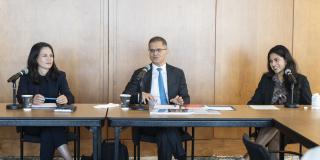
Amid mounting geopolitical tensions and growing questions about the future of international cooperation, two former presidents of the United Nations General Assembly came together at Columbia’s Institute of Global Politics (IGP) on October 2 to examine the challenges facing multilateral diplomacy.
The discussion came as the UN prepares to select its next secretary-general and replace António Guterres, a process that has highlighted many of the same tensions shaping the organization. Vuk Jeremić, the former Serbian foreign minister and president of the General Assembly’s 67th session from 2012-2013, and Annalena Baerbock, Germany’s former foreign minister and the most recent president of the General Assembly, drew on their UN experiences to discuss the thorny politics of the selection process and its impact on the future of multilateralism. IGP Student Circle Member Kratima Divakar moderated the conversation after winning the 2025 UN Security Council Simulation at Columbia SIPA.
“We are in a geopolitical recession, if you will,” Jeremić said, describing a period of deepening fragmentation and declining international cooperation that contrasts with what he characterized as a more cooperative era around the adoption of the Sustainable Development Goals (SDGs) and the Paris Climate Agreement in 2015. He attributed the downturn to three major drivers: Russia’s estrangement from the West, the rise of China and resulting shifts in global power, and political upheaval within a number of Western democracies. Together, he said, these forces have fundamentally altered the geopolitical environment in which the UN operates.
“This election of the secretary general is going to be the first to take place inside a geopolitical recession,” Jeremić noted. “So there’ll be much more transactionalism, there’ll be much more intensive power games as a result of it.”
Those pressures are unfolding as the UN confronts a widening set of challenges, from ongoing wars and threats to international peace to climate change and rapid technological change, including the rise of AI.
Drawing on his own unsuccessful bid for the SG position in 2016, Jeremić said the race forces candidates to navigate the competing interests of the Security Council’s permanent members before pursuing their own ambitions for institutional reform. Although the General Assembly formally appoints the secretary-general following a Security Council recommendation, the Council’s five permanent members – the US, China, Russia, France, and the UK – hold the decisive influence through their veto power.
Candidates may arrive with ambitious plans for reform, but winning the support of the permanent members requires understanding what each country wants from the UN and from the next secretary-general.
Baerbock argued that the General Assembly should not simply accept the outcome of those power dynamics. While acknowledging the Security Council’s influence over the selection, she said the process represents a test of whether the Assembly’s 193 member states are prepared to assert their own priorities. She pointed in particular to the possibility of electing the first woman to serve as secretary-general, saying that the issue goes beyond representation and speaks to the UN’s credibility after eight decades without a woman in the position.
“If the UN is founded on human rights, if the UN is founded on equal rights for everybody, men and women, how can you explain 80 years later that you could not find a woman to lead?” Baerbock said.
The discussion later broadened from the SG race to the UN’s struggle to adapt its institutions to a changing global balance of power. Jeremić cited India’s absence from the Security Council as a particularly stark example, noting the world’s most populous country remains outside the Council’s permanent membership despite its growing economic and political weight. He and Baerbock also discussed the push for greater representation for Africa, whose countries have long called for a permanent seat on the Council.
Both Jeremić and Baerbock acknowledged that institutional reform is more difficult during periods of geopolitical instability. But Jeremić argued that the UN will ultimately have to change if it is to remain relevant in the 21st century.
The next secretary-general will inherit an organization under pressure – from geopolitical division and demands for reform to mounting financial constraints. The selection process itself may offer an early indication of how much room the UN has to shape its future, and how much of that future will continue to be determined by a divided international system.