Image
Note: AI was used in the production of this story. All quotes have been verified by human editors, and the final story was written and edited by humans to ensure accuracy.
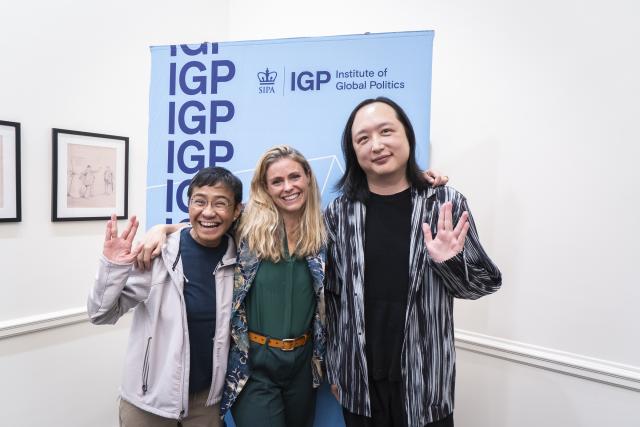
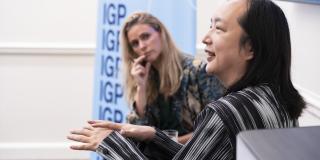
On September 14, Columbia SIPA cohosted a roundtable conversation with Audrey Tang on openness in AI development and whether it can serve as a practical foundation for public trust, security, and democratic oversight, rather than an abstract ideal. Taiwan's first Digital Minister, Tang is currently a civic hacker as well as coauthor of Plurality: The Future of Collaborative Technology and Democracy. She is also an inaugural Senior Accelerator Fellow at the Oxford Institute for Ethics in AI and an IGP Carnegie Distinguished Fellow. The conversation was moderated by Camille François, assistant professor of practice at Columbia SIPA and codirector of IGP's Technology & Democracy Initiative.
The discussion traced a line from Tang's early work in the free software movement through her direct role building Taiwan's participatory digital governance systems to her current work on AI trust and safety. Free software underwrites much of the technology people already rely on daily, according to Tang, noting that “a lot of the modern tech society is built on free software” — from Linux to Signal to Wikipedia — and framed that lineage as directly relevant to how AI systems should be built and governed.
Much of the conversation centered on Tang's pathbreaking work with Taiwan's "vTaiwan" platform and its bridging-based approach to online discourse, which surfaces common ground between people who "usually disagree with each other" rather than amplifying the loudest voices. She connected that approach to her current role on the board of ROOST, the child-safety and AI trust-and-safety nonprofit she and Maria Ressa colaunched in 2025 at the Paris AI Action Summit.
Tang described ROOST's aim as building models that run locally, are community-governed, and can explain their own decisions — an attempt, she said, to hold child protection and user privacy together rather than trading one for the other. “When it comes to safety and security, openness is not a poison. It is the antidote,” she said.
Tang returned repeatedly to the idea that apparently irreconcilable camps in AI policy — safety-first versus openness-first, existential-risk-focused versus harms-focused — are often talking past one another rather than genuinely disagreeing. “All these debates, for me, are just really excuses to build our civic muscle, to build the unlikely trust among people who hear about the same thing, but from extremely different angles,” she said.
Because today's models are pretrained on collaboratively built material like Wikipedia and GitHub, she argued, they start out modeling group cooperation — but optimization pressure can push them toward treating people as obstacles rather than collaborators. Reframing the dynamic driving AI development, she said the operative question should not be who is winning a race to build the most powerful model, but “who is missing, who is still not touched by the transformative potential of this technology.”
On the danger of treating capability as the only goal, she was direct: "Nobody wants to win the suicide race." Tang closed by drawing on Taiwan's education reforms, which she said were restructured around three qualities that remain distinctly human once AI can automate most optimization tasks: “Curiosity, collaboration, and civic care.” She extended the same standard to AI systems themselves, telling the packed house of SIPA students: “Be the model you want to see in the world. Be the agent you want to see in the world.”