
News and Event Highlights
News and Event Highlights

Academic research has coalesced around the proposition that there are significant impediments to cyber coercion. Yet, many practitioners in the United States continue to espouse beliefs grounded in its efficacy. This article by IGP Emerging Technologies, Intelligence, and Security Initiative Cofounder Erica Lonergan categorizes the evolution and consequences of this scholar-practitioner gap through a comparative review of the academic literature and policy debates within the United States.

When we read about yet another shooting linked to online hate, or another violent network spreading across social media, the common refrain is that “social media platforms must do more.” Indeed, my own research in online extremism and content moderation shows that while content moderation takedowns have soared on major sites over the past several years, extremists still find plenty of digital spaces to recruit, organize, and call for violence, writes IGP Emerging Technologies, Intelligence, and Security Initiative Cofounder Tamar Mitts.
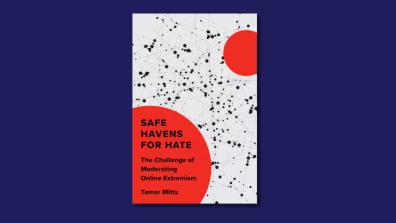
Safe Havens for Hate: The Challenge of Moderating Online Extremism, a new book by IGP Emerging Technologies, Intelligence, and Security Initiative Cofounder Tamar Mitts, draws on a wealth of original data on more than a hundred militant and hate organizations around the world to show how differing moderation standards across platforms create safe havens that allow these actors to organize, launch campaigns, and mobilize supporters.
Cyberspace is a primary battleground of the twenty-first century. Yet, grand strategists have been slow to address cyber strategy. IGP Emerging Technologies, Intelligence, and Security Initiative Cofounder Erica Lonergan and coauthor Michael Poznansky examine the implications of four prominent American grand strategies—restraint, deep engagement, liberal internationalism, and conservative primacy—for core topics in cyber strategy.

Military organizations are generally defined by a “cult of the offensive.” For cyberspace, this gives rise to an empirical puzzle, at least in the United States. What accounts for the early restraint and skepticism about cyber offense publicly expressed by many US military cyber leaders? In this article, IGP Emerging Technologies, Intelligence, and Security Initiative Cofounder Erica Lonergan explores the US military’s approach to cyberspace as a theory-developing case study.
In the US military, an officer who had never fired a rifle would never command an infantry unit. Yet officers with no experience behind a keyboard are commanding cyber warfare units. This mismatch stems from the US military’s failure to recruit, train, promote, and retain talented cyber warriors. The Army, Navy, Air Force, and Marines each run their own recruitment, training, and promotion systems instead of having a single pipeline for talent. The result is a shortage of qualified personnel at US Cyber Command (CYBERCOM), which has responsibility for both the offensive and defensive aspects of military cyber operations, writes IGP Faculty Member Erica Lonegran.
Do civilians defer to military preferences about US cyber strategy? The civil-military relations literature has only cursorily addressed this question. This article by IGP Emerging Technologies, Intelligence, and Security Initiative Cofounder Erica Lonergan aims to fill this gap.

Cyberspace's role in military power is vociferously debated. But how do these ideas manifest in cyber strategy? In this article, IGP Emerging Technologies, Intelligence, and Security Initiative Cofounder Erica Lonergan and coauthor Jacquelyn Schneider trace the development of ideas about military cyber power, with a focus on the US.

Social media is frequently an arena of intense competition among major political actors across the world. In this article, IGP Emerging Technologies, Intelligence, and Security Initiative Cofounder Tamar Mitts and coauthors argue that a fruitful way of understanding this competition is as coalitions among key actors and their networks of followers, mapping out networks of narrative alignment and conflict on Pakistani social media and providing important insights into the relationships among the major political parties, military, media, and dissidents. Future research can fruitfully explore the causes and effects of powerful social media coalitions.
Signaling is a core element of international crisis bargaining and coercive diplomacy. In this article, IGP Emerging Technologies, Intelligence, and Security Initiative Cofounder Erica Lonergan and coauthor Shawn W. Lonergan develop a theory of signaling in cyberspace, arguing that, although cyber operations are not particularly well suited as costly signals of resolve or capabilities in the context of coercive diplomacy, they have a distinct utility for signaling to manage escalation risks.