IGP Launches Emerging Technologies, Intelligence, and Security Initiative
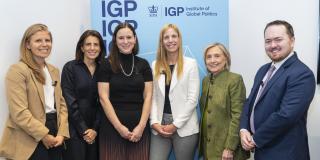
On October 21, the Institute of Global Politics launched its new Emerging Technologies, Intelligence, and Security Initiative to examine how technological innovation is reshaping conflict. To kick off the initiative, IGP convened a panel of researchers and national security experts to discuss a new IGP report, Influence Under Fire: Mapping Wartime Information Operations in the Middle East, 2023-2025. SIPA Dean Keren Yarhi-Milo and Secretary Hillary Rodham Clinton provided opening remarks to frame the initiative within IGP’s mission to bridge scholars and practitioners and tackle emerging challenges like information warfare.
SIPA professor Tamar Mitts — one of the report’s coauthors and codirector of the new initiative — joined the panel, which was moderated by her codirector, SIPA professor Erica Lonergan. Jessica Brandt, senior fellow for technology and national security at the Council on Foreign Relations, and Emerson Brooking, nonresident senior fellow at the Atlantic Council’s Digital Forensic Research Lab, rounded out the wide-ranging discussion.
“Erica and I have been thinking a lot about the issues that this initiative will tackle,” Mitts said. “Specifically, given our diverse backgrounds and in our own research, we started seeing a lot of things that kind of are missed in the silos between different areas of research and policy. And part of what we are trying to do here is to really kind of look between the cracks and try to understand this world better.”
One of the central tensions in fighting malign influence operations is the conflict between freedom of speech and access to information on the one hand, and mitigating the harm caused by targeted campaigns on the other.
“We know that our openness creates opportunities for hostile actors,” Clinton said in her introduction. “We've got to figure out how to balance our freedom with security.”
Beyond the challenges posed by the speed of technological innovation and information diffusion, the US struggles to present a cohesive narrative, one that promotes freedom and democracy as the core of the American project.
“We do need an information strategy that goes on offense, but I think we need to exploit our adversaries' fragility to open information,” Brandt said. “It puts the adversary on its back foot, supporting local media that holds truth to power, and then using the truth to highlight the failures and false promises of dictatorship. That's the north star, and then I think you need to organize the bureaucracy to be able to do that.”
Furthermore, a lack of coordination between tech companies, academics and researchers, intelligence agencies, and policymakers makes it easier for foreign actors to exploit the information environment and enforce their own narratives. “We need folks at the DOJ to be working on this problem, just as we need folks in the intelligence community, at State,” Lonergan said. ”There's a role for every actor here.”