IGP and CGEP Convene Roundtable on Future of Climate Finance
Recent flooding in Nepal has not only destroyed homes and roads but has also wiped out a significant portion of the country’s economic growth. Though such climate disasters are becoming both more frequent and more expensive, the institutions that are supposed to pay for them remain underfunded, politically fraught, and still under construction.
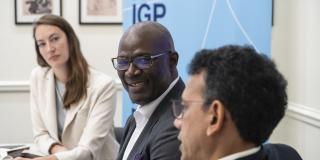
To understand the financial impact of these kinds of climate-related shocks, on September 18, the Institute of Global Politics (IGP) and the Center on Global Energy Policy (CGEP) hosted a roundtable with Ibrahima Cheikh Diong MIA ’94, executive director of the Fund for Responding to Loss and Damage (FRLD). The conversation, attended by around two dozen SIPA professors, alumni, and students, covered the geopolitics of who pays for climate disasters, the amount of money still needed to adequately respond to climate-induced risks, and what it takes to build a career in the field of climate financing.
Diong, who has also held posts in Senegal’s private sector and at the United Nations before assuming leadership of the fund, opened his remarks by pointing to recent flooding in Nepal, which he said wiped out about 80 percent of the country’s GDP growth. According to Diong, the disaster serves as proof that the countries suffering the highest human toll from climate change are rarely the ones responsible for causing it. “Today is Nepal,” he said. “Tomorrow it’s other countries.”
He argued that this imbalance lies at the heart of the lack of global solidarity regarding climate finance and explained the many decades of failed attempts to establish a loss and damage fund. Previous attempts foundered, he said, because they were framed around reparations — language some developing countries were reluctant to accept. Reframing the request around global solidarity instead has removed much of that resistance, as countries from South Korea to the United Arab Emirates have agreed to join the FRLD, despite having no obligation to do so.
As Diong pointed out, standing up a fund is only the first step. Establishing governance and a board, securing pledges, and converting those pledges into actually disbursed capital all present their own difficulties. He stressed the need for funds to be guided by the principle “country-led, country-owned,” which means addressing the needs that countries have rather than imposing particular solutions, while still ensuring the institutions necessary to absorb and make use of the money are in place.
Because public money alone cannot cover the scale of climate costs, Diong said financing needs to be diversified, so that it does not rely on any single source that could, in his words, be withdrawn at any point by a single individual.
Diong was joined by Gautam Jain PhD ’96, senior research scholar at CGEP with experience in private finance and emerging markets.
Jain picked up that thread, citing an estimated financing gap of 70 to 99 percent between what is needed for climate mitigation, adaptation, and loss and damage and what’s currently available. Public funds must be focused on covering post-disaster financing, where private capital has shown little interest because there is no return on it, he added.
Meanwhile, because mitigation and adaptation projects can generate revenue, if the financing gap is to be filled and funding sources diversified, those projects must be structured to attract private investors.
As one model that could attract the private sector, Jain described catastrophe bonds, which function like standing insurance on a region. Investors collect premiums until a climate disaster occurs, at which point capital is released quickly, offering high returns for investors and quick liquidity for the affected countries. He also noted that the model lets countries draw on private-sector resources for assessing disaster risk. Meanwhile, pooling countries that face similar climate risks can make catastrophe bonds’ premiums more affordable.
The event ended with audience questions around career advice. Diong emphasized that the value of the SIPA degree, which combines politics, policy, and environmental training, lies in the fact that climate finance requires an understanding of the financial and political ecosystems through which money flows. According to him, delivery is just as important as fundraising, making data management skills and a demonstrated ability to deliver essential. Jain added that beyond building credentials, students should keep asking what drives them professionally — a question that’ll ensure they find fulfillment in their career, and one that eventually got him from Wall Street to academia.